
This article will focus on Mastering Futures Prop Firms and the way traders are using funded accounts, strict risk management, and exchange data like the Chicago Mercantile Exchange to their advantage.
You will discover the reasons behind the rapid growth of futures prop firms and how they provide a trading environment that is professional and offers greater transparency.
What Are Futures Prop Firms?
Futures prop firms finance traders to participate in futures markets using the firm’s money instead of the traders’ own money. Before getting a funded account, traders must clear an evaluation process which involves risk management, consistency, and profitability assessments.

These firms use centralized, regulated markets and often data feeds from the CME which promotes fair and transparent pricing. As opposed to Forex prop firms, there is a decreased conflict of interest as traders’ positions are placed on real exchanges.
In return, traders are required to comply with stringent rules regarding drawdown, position sizing, and risk control in order to retain financing, and they must share a portion of their earnings with the firm.
Understanding CME Data
Comprehending data from the Chicago Mercantile Exchange (CME) is vital for traders looking for precise market insight. Due to CME data originating from a centralized exchange, every trade is documented and confirmed, in contrast to decentralized market data. CME data includes real-time pricing, actual volume, and order flow data (including Level 1 and Level 2 data) and market depth).
This gives traders the ability to understand exactly where buying and selling pressure is located. Traders receive CME data in a standardized format, reducing the chances for data manipulation and better supports informed decision making based on data in the futures markets.
Why Traders Are Leaving Forex
Decentralized Forex Broker Prices: Prices for currencies differ from one brokerage firm to another. This causes price discrepancies which cause users to lose trust in the market.
Brokers Can Take Advantage of Clients’ Orders: Stop loss hunting, slippage, and price manipulation are things traders have to consider because brokers are considered the counterparty to their trades.
No Volume: Because of the lack of volumes for currencies, the Forex market is less analyzable than futures markets.
Wider Spreads and Hidden Costs: Variable spreads and hidden costs are a common thing in Forex trading, and these costs reduce traders’ profits over time.
No True Volume Data: Some brokers make money when traders lose which is a built in structural disadvantage for retail traders.
Opaque Markets: Traders have to take things on faith because there are no regulated central exchanges in Forex trading.
Inconsistent Speed of Execution: The quality of execution is inconsistent, and traders can lose money from having slippage that is caused by their brokers.
Fewer Options: The rise of the futures markets is drawing serious traders away from Forex. This is because they are offered transparency, fair pricing, and institutional-grade tools.
Advantages of CME Data in Futures Trading
Transparency in Centralized Markets
The CME has a single, regulated source of market data. Thus, all market participants have access to the same market data, pricing, and transactions.
Genuine Volume Data
CME data is not from a fragmented, decentralized market. Instead, it is from a centralized, fully regulated marketplace which means traders are able to use real market data to gain insight into actual buying and selling.
Order Flow Data is Trustworthy
Traders can obtain Level 2 data and depth of the order book to see where liquidity, support and resistance, and institutional trading are.
Reduced Risk of Market Manipulation
Because trading occurs in a centralized marketplace, there is a lessened chance of market manipulation due to brokerage pricing, and it is less likely for a broker to “hunt” for stops.
Uniform Pricing from all Brokers
Brokers that are connected to the CME have a uniform data feed which results in uniform pricing, and therefore, the brokers can improve their reputations.
Execution is More Accurate and Rapid
Traders are able to use a direct exchange for more streamlined fill quality, which lowers slippage and higher efficiency in trading.
Data Available to Traders is of Institutional Quality
Retail traders also have greater access to institutional and professional data.
Improvement of Trading Strategy
Quality data boosts the use of strategies like order flow trading, footprint charts, and volume profiling.
Key Benefits of Futures Prop Firms

Access to Higher Trading Capital: After completing evaluations, traders gain the ability to work with high amounts of capital, meaning greater potential for profit while risking none of their own money.
Data Feeds of Higher Quality: With the ability to work with data seen by the Chicago Mercantile Exchange, traders can make informed decisions.
No Conflicts of Interest: Since traders’ positions are placed on real exchanges, there is little chance of the broker pushing against the trader, meaning everyone wins.
Disciplined Trading: With strict rules governing how much a trader can lose, traders learn how to better control their risk.
Large Shares of Profit: Traders are often given between 70% to 90% of any profits made.
Ability to Lose Less Personal Money: Traders are only given the ability to lose money through their evaluations or a subscription, while the firm takes the risk.
Growth as a Trader: Traders can increase their account size, and subsequently their position size to make even more money.
Environment of a Professional Trader: Traders are given a chance to work in the positiva environment of a real firm so they can work consistently to develop their skills.
Comparing Futures vs Forex Trading
| Feature | Futures Trading | Forex Trading |
|---|---|---|
| Market Structure | Centralized exchange (e.g., Chicago Mercantile Exchange) | Decentralized (OTC market) |
| Transparency | High – all trades recorded and visible | Low – broker-dependent pricing |
| Volume Data | Real, accurate volume available | No true centralized volume |
| Pricing | Standardized across all platforms | Can vary between brokers |
| Execution | Direct exchange execution | Broker-controlled execution |
| Manipulation Risk | Low due to regulation | Higher due to broker influence |
| Trading Costs | Fixed commissions, tighter spreads | Variable spreads + hidden fees |
| Leverage | Moderate, regulated | Often very high (riskier) |
| Liquidity | High in major contracts | High but fragmented |
| Trading Hours | Nearly 24 hours (with breaks) | 24/5 continuous |
| Learning Curve | Slightly steeper (order flow, data) | Easier for beginners |
| Best For | Serious, data-driven traders | Beginners and retail traders |
Tips to Succeed with CME-Based Prop Firms
Learn Risk Management First
Strict control of drawdowns, position sizing, as well as daily loss limits, are critical to achieving success. Prop firms aim for consistency, not for large wins.
Know CME Data
You need to know how to read the different types of CME data, as well as how to identify volume and liquidity.
Apply Order Flow and Volume Analysis
Order Flow Analysis is an institutional focus. Use the right tools, such as footprint and DOM (Depth of Market) charts, to identify and capitalize on high probability flows.
Use a Good Trading Plan, and Stick to It
This includes having a clear set of entry and exit rules, as well as a defined risk strategy. Avoid thinking about setting an order.
Know What Trading Hours to Trade
Trade when there is high liquidity in the market (like when the US market opens) for better order executions and for optimal order spreads.
Discipline is Important in Evaluations
You need to pass the evaluations without trading impulsively, or becoming frustrated.
Have a Trading Journal and Review It
To improve, you need to know how you trade, as well as isolate the causes of your gains and losses.
Leverage Appropriately
Risking accounts like you do is part of the reasons you are losing accounts.
Stay Calm
Your success may depend on your ability to maintain control, as the destructive forces of fear and greed tend to undermine a winning position.
Challenges of Futures Prop Firms
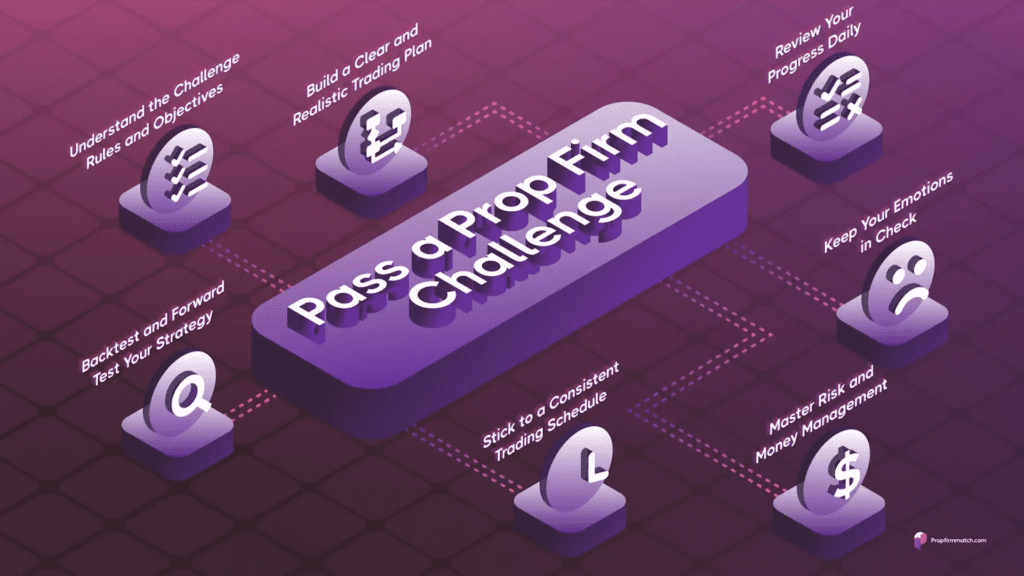
Strict Evaluation Process: Evaluation phases tend to be long and require consistent positive trading results without hitting drawdown limits to pass.
Tight Risk Rules: Daily loss limits, trailing drawdowns, and position limits can be detrimental to your trading style.
Data and Platform Costs: Professional trading systems and high-quality feed access from the Chicago Mercantile Exchange come with additional costs.
Steep Learning Curve: Order flow trading, futures market, and contract specifications can be difficult to grasp.
Psychological Pressure: If firm rules and objectives impact your trading, you may be more psychologically impacted than you realize.
Limited Trading Freedom: The firm may restrict you from using certain cash management strategies, such as overnight trading and trading around news events.
Profit Sharing Model: You are required to pay the firm a percentage of the profit, making your account more profitable than the firm’s.
Risk of Rule Violations: Single account violations (excess drawdown, for example) can lose you your account.
Consistency Requirement: If you are aggressive or inconsistent, it will be virtually impossible for you to succeed.
Scaling Takes Time: Most challenges require you to reach specific milestones, making the account fast to grow and the payouts fast to slow.
Future of Prop Trading
Proprietary trading’s evolution focuses on transparency and increasingly data driven approaches. Greater access to institutional quality tools is available to retail traders. As traders access reliable stream data from the Chicago Mercantile Exchange, opaque trading is losing favor to more transparent, regulated options.
Conversely, automated approaches to trading and risk management are becoming smarter due to advances in AI and other technologies. The evolution of prop trading is more professional, with stricter risk controls and increased trust from significant traders. The trend is evident in the rise of futures-based prop trading firms for their fair execution and scalable opportunities.
Conclusion
In mastering futures prop firms, the key components are the benefits of being open, disciplined, and making decisions based on data. With the shift of more traders flowing towards centralized markets, like the Chicago Mercantile Exchange, the benefits of having true volume, fair pricing, and less manipulation stand out.
Although the process includes challenges such as governing rules and learning the process, those who stick to risk management and consistency are the ones who see the greatest potential. In the end, futures prop firms are a more professional and reliable option for traders wanting to achieve success on a more sustainable basis in a constantly changing trading environment.
FAQ
A futures prop firm is a company that provides traders with capital to trade futures markets. Traders typically pass an evaluation and then share profits while following strict risk rules.
Data from the Chicago Mercantile Exchange offers real volume, transparent pricing, and reliable execution, giving traders a more accurate view of the market.
Futures trading is centralized and transparent, while Forex is decentralized and broker-driven, often lacking true volume data and consistent pricing.
They can be, but beginners may face a steep learning curve. Understanding risk management and market structure is essential before starting.