

The following article will detail Prop Firm Rules Explained and provide clarity for traders on daily loss limits, max drawdown, risk management rules, and other common setups from proprietary trading firms.
These rules are crucial to completing challenges, preserving capital and staying funded. Traders aiming to compete in the prop firm arena need to adhere to their respective guidelines in order to trade confidently, consistently, and professionally.
What Is a Prop Firm?
A proprietary trading firm (or prop firm) is an organization that supplies traders with large amounts of capital to trade financial markets, allowing them to profit without risking their money. Rather than depositing large amounts of money, traders typically complete an evaluation or challenge that assesses risk management, consistency and profitability.

After funding, traders receive a portion of the profit and are responsible for any losses as long as they remain within established guidelines. They generally provide access to forex, stocks, indices, commodities, and cryptocurrencies via professional trading platforms.
To protect the firm’s capital, strict rules such as daily loss limits and maximum drawdown apply. Because the prop firm is looking to find disciplined traders who are able to produce consistent returns and risk responsibly.
What Is a Daily Loss Limit in Prop Firms?
This means a daily loss limit is the maximum amount you can lose in one trading day before your account is limited or terminated. In 2026, most prop firms enforce limits of between 3% and 5% accounts size.
Closed trades and floating losses get lumped in the same rule, which is often new information for fresh traders.
Other companies reset at midnight server time, while futures firms typically reset at market close. Not following this rule is still the top reason why traders fail prop firm evaluations worldwide.
Prop Firm Rules Explained
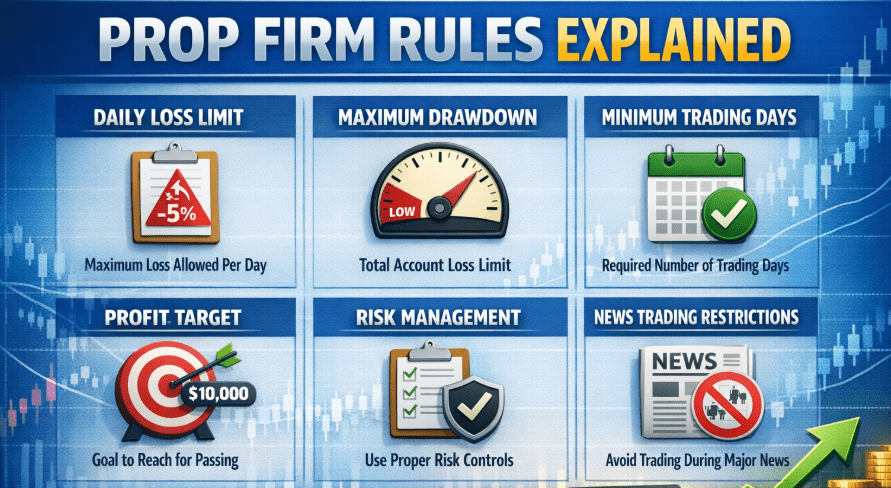
Daily Loss Limit
The daily loss limit is the maximum amount a trader can lose in one trading day across all closed trades and unclosed losses. Exceeding this threshold is most often an account loss outright, or a disqualification from the challenge.
Maximum Drawdown
Maximum Drawdown: Total loss on an account before being cut off. Dynamic drawdown limits safeguard capital from protracted losing streaks and can be implemented as static (fixed) or trailing drawdown.
Profit Target Requirement
Profit target: They have to hit a required net profit percentage in order to pass the evaluation. In challenge phases this rule is critical and must be adhered to without incurring a Drawdown, Balance or Execution Limit.
Risk Management Rules
Risk management rules include disciplined trading with the use of stop-loss, a controlled leverage applied, and always keeping lots sized stable. This is something all prop firms will follow closely to make sure at least they are trading in a way that retains capital rather than relying on being over-leveraged.
Minimum Trading Days
Traders must make transactions on at least three days for minimum trading days. This rule reduces passing an evaluation on one trade due to being fortunate, and instead helps promote (hope) for more consistent trading behaviour over time.
Consistency Rules
Consistency rules state that profits have to be established over multiple trades, and not through one fat position. This enables firms to find disciplined traders and avoid gambling-style strategies, which result in volatile or unsustainable performance.
News Trading Restrictions
News trading restrictions either limits or prohibits trading during important economic releases like CPI, NFP, interest rate decisions… Such events can create high volatility, leading to rapid losses and immediate rule-breaking.
Holding Trades Rules
These are rules that outline if positions can be open overnight or on weekends (holding trades). Some prop firms forbid this to limit against gap risk and some allow you but only on certain account conditions.
Scaling Plan Rules
Traders that follow the plan will earn larger capital allocations as they demonstrate consistent profits and disciplined execution. In order to qualify, traders normally have to demonstrate consistent performance within the guidelines of all rules and in most cases avoid going into a significant drawdown.
Rule Violation Consequences
Prop firms protect their capital with stoic discipline so the penalties for breaching rules are extreme. Depending on the severity of the violation, we may reset your account, remove offending challenges and/or payouts, suspend your account or permanently cancel it if you break core rules.
Static vs Trailing Drawdown
The primary distinction between static and trailing drawdown is flexibility. Static drawdown adjusts only the size of the risk floor set in stone, whilst trailing drawdown tries to consistently shift as accounts grow. Due to limited risk room due to profit spikes, trailing systems are a killer for aggressive scalpers.
In contrast, static systems keep traders in positions longer without putting added pressure. Research from recent years highlights how more traders fail trailing drawdown challenges stemming from psychological factors, as well as equity fluctuations, than with static models.
How to Stay Within Prop Firm Rules?
By using a risk only 0.5% to 1% per trade you will lose much less than 2% maximum daily loss limit set or twice that in monthly drawdown and avoid being taken out by normal market fluctuations
Define a personal daily stop-loss level that is below the firm’s limit such that you exit early, before you have reached the maximum daily loss limit, and thereby avoid risk of account termination.
Track equity in real time, not just account syndication (due to many prop firms will count floating losses as drawdown and rule violations)
Always use a stop-loss on every trade to manage downside risks and limit capital losses so that no one unmanageable position can exceed prop shop risk limits.
Do not over trade after a losing trade: vengeance trading means making emotional decisions which lead to bigger losses and the quickest way to violate your daily risk rules.
Avoid position size discrepancies and cut back the dimensions of every single trade such that no one trade could ever trigger catastrophic impairment to your home, nor transport you inside a range of drawdown floor limits.
Log your daily loss, drawdown and open exposure prior to every new position (to know how much risk is left!)
Common Mistakes Traders Make
Just watching closed trades and completely ignoring floating drawdown that leads numerous traders to hit daily loss limits when open positions remain active.
Over-leveraged on one trade, one losing position large enough to either take out an account or breach drawdown rules of prop firm.
Static and trailing drawdown is confused, which causes traders to incorrectly calculate risk leading them to inadvertently breach the firm’s total loss limit.
Trading back losses with over sizing leading to emotional mistakes, bad setups and further drawdown of your account.
Non-placing a stop-loss, Via which the account is subject to limitless losses and has excessive achievement rate of blowing out the challenge in a single shot.
Taken literally — and getting confusing daily reset times, which leads to putting trades too early or too late and then accidentally busting the daily loss rules.
Focusing exclusively on profit targets and neglecting risk limits, which is a sure way to become more aggressive with your trading before crashing your account well beforehand of getting to the goal.
Understanding Daily Loss Limit
One of the most crucial rules when it comes to prop firm trading is the daily loss limit, which basically prevents you from losing too much money in a single day of trading. It preserves the firm’s capital and compels traders to hedge risk appropriately.
The limit typically covers both realized losses and unrealized losses of the open positions. Once a trading account is breached, regardless of whether later trades recover the equity above the threshold percent loss.
Daily loss is normally calculated from that day’s starting balance or equity. However, this rule promotes discipline in trading, prevents revenge trading and keeps traders focused on consistency instead of chasing large profits.
Understanding Maximum Drawdown
Maximum drawdown — the total amount a trading account can lose before breaking prop firm rules. Call-account rule: Unlike the daily loss limit, this one tracks overall drawdown based on your initial balance or highest equity reached. It guarantees traders not to lose a significant portion of the company’s capital over some time.
Drawdown can be static, with the limit remaining constant, or trailing, with the loss limit raising as profits increase. Drawdown typically includes both closed trades and floating losses. To control your maximum drawdown, you need to implement steady risk management, smaller position sizes, and avoid making emotional trades during a losing streak.
Daily Loss vs Maximum Drawdown (Key Differences)
| Feature | Daily Loss Limit | Maximum Drawdown |
|---|---|---|
| Definition | Maximum loss allowed in one trading day | Maximum total loss allowed on the account |
| Time Period | Resets every trading day | Applies for the entire challenge or funded account |
| Purpose | Prevents large single-day losses | Protects account from long-term capital decline |
| Calculation Base | Based on daily starting balance/equity | Based on starting balance or highest equity |
| Includes Floating Loss? | Yes, usually includes open trades | Yes, includes open and closed losses |
| Reset Rule | Resets at broker/server day reset | Does not reset until challenge ends |
| Risk Focus | Short-term risk control | Overall account survival |
| Common Limit Range | 3%–5% per day | 8%–12% total account loss |
| Trader Mistake | Overtrading or revenge trading | Holding losing trades too long |
| Difficulty Level | Hard psychologically | Hard strategically |
| Account Breach Trigger | Exceed daily allowed loss | Account equity falls below drawdown limit |
| Best Protection Strategy | Lower daily risk per trade | Maintain consistent risk management |
Risk Management Strategy to Stay Safe
Follow the 1% Risk Rule
- Making sure you always risk 0.5%–1% of your account balance per trade
- Stops your Daily Loss Limit from being hit too early
- Enables survival during longer losing streaks
Always Use a Stop-Loss
- Always have exit levels set before entering a trade
- Safeguards account against unexpected market price movement
- Needed for prop firm rule adherence
Control Position Size
- Don’t let emotions make your lot size decisions
- No big bets following wins or losses
- Keeps drawdown under control
Restrict The Number Of Trades Per Day
- Do not overtrade and revenge trade
- — Only executing high-quality setups
- Quality beats quantity
Establish a Personal Daily Loss Limit
- No more trades below firm caps
- For instance: Let’s say a firm permits losses of 5%–keep it to 2–3%.
- Adds an extra safety buffer
Protect Profits Early
- Adjust stop-loss to break even as soon as you can
- Bank partial profits on strong moves
- Reduce emotional pressure
Avoid High-Impact News Trading
- There can be sudden volatility due to major news
- Slippage can snap rules in a breath
- Trade after markets stabilize
Maintain Risk-Reward Ratio
- Target at a min 1:2 risk-to-reward trades
- It is able to provide insight towards larger losses.
- Improves long-term consistency
Track Your Drawdown Daily
- Look at equity, not just balance
- Review losses regularly
- Make sure risks are adjusted when the performance is lower
Trade With a Written Plan
- Understand entry, exit and risk in advance of trading
- Removes emotional decision-making
- Builds professional trading discipline
Daily Loss Violations and How Professional Traders Avoid Them
The seasoned prop traders seldom trade at official loss limits. They do not do that; instead, they set personal limits, which they call a soft stop, which is far less than firm rules. A lot of trades are lost, so after 30% to 50% of the daily allowance, some professionals purposefully stop trading.
They mitigate position size once they incur a loss in order and do not trade on important economic announcements. AI-assisted risk dashboards and automated alerts are being utilized by even professional traders to track real-time drawdown exposure. Staying disciplined enables them to survive and consistently preserve funded accounts in 2026 markets.
Best Trading Habits for Prop Firm Success

Trade With a Clear Plan
- Before entering a trade, you must define By: Entry Stop-loss Take-profit
- Avoid impulsive decisions
- Follow rules, not emotions
Prioritise consistency over large profits
- Set daily goals that progress rather than big wins
- Regular profits small enough to cross challenges safely
Respect Risk Limits
- Always keep a safe distance from daily loss and drawdown limits
- Strategic focus on risk management
Trade Only High-Quality Setups
- Be patient and wait for strong confirmations
- Don’t make trades when the market is hazy
Maintain a Trading Journal
- Track entries, exits, errors and even your feelings
- Valuable in recognizing trends and enhancing performance
Control Trading Psychology
- No revenge trading after losses
- Keep your cool when winning games
- Discipline beats excitement
Stick to One Strategy
- Don’t keep switching systems
- Learn one setup really well, rather than pursue new strategies
Choose the Right Trading Session
- Only make transactions during active market hours with sufficient liquidity
- Keep away from low-volatility/random market conditions
Tools That Help Track Loss & Drawdown
| Tool | Purpose | Key Features | Best For |
|---|---|---|---|
| Trading Journal Software | Track trading performance | Trade history, drawdown analysis, win rate tracking | Performance improvement |
| Prop Firm Dashboard | Monitor rule compliance | Real-time equity, daily loss alerts, drawdown tracking | Prop firm challenges |
| Risk Calculator Tools | Manage position sizing | Lot size calculation, risk % control, stop-loss planning | Risk management |
| TradingView Risk Tools | Analyze trades visually | Chart analysis, strategy testing, equity tracking | Trade planning |
| Excel / Google Sheets | Custom tracking system | Manual loss tracking, performance dashboard | Advanced discipline |
| Broker Analytics Reports | Review trading history | Detailed reports, equity curve, P&L summary | Performance review |
| Mobile Risk Alert Apps | Monitor account remotely | Loss notifications, equity alerts, mobile monitoring | On-the-go traders |
Conclusion
The first step towards being a successful funded trader is to understand the rules of prop firms. Limit daily losses, maximum loss, they are not constraints, more protection systems to train your discipline and professional risk habits. Traders do not fail challenges because of strategy, they fail because they did not manage risk and traded from emotions.
Many traders have significantly better odds of being profitable pass and retain a funded account by following loss limits, position size, and consistency over profit. Survival is the first rule of prop trading. Learn the rules, avoid losing money and profit will come in time.
FAQs
Prop firm rules are risk management guidelines set by proprietary trading firms to protect their capital. These usually include daily loss limits, maximum drawdown, profit targets, and trading behavior restrictions.
If you violate rules like daily loss or drawdown limits, your account is typically breached, and the challenge or funded account may be terminated or reset.
The daily loss limit is the maximum amount you can lose in one trading day. It includes both closed trades and floating losses from open positions.
Maximum drawdown is the total loss allowed on your account from the starting balance or highest equity level before the account fails.
