


I will analyze the Best Prop Firms Using Liquidity Aggregation in this post and will help with the understanding of trade execution in an efficient manner. This analysis will concentrate on the top firms based on liquidity, spreads, execution quality, trading platforms, account choices, profit splits, drawdown levels, and overall trading terms. This analysis provides traders with a framework for evaluating prop firms and their varying trading conditions.
Why Choose Prop Firms Using Liquidity Aggregation
Competitive Pricing: More liquidity sources create more competitive bid-ask spreads.
Access To More Markets: Aggregated liquidity grants access to more market prices.
Seamless Order Execution: Well designed liquidity aggregation systems can spot the best liquidity.
Execution Slippage Becomes Less Prevalent: During average market conditions, slippage is reduced with greater liquidity.
Greater Liquidity Limits: Combining multiple providers means that more liquidity is made available to more instruments.
Scalping Is Easier: Spreads and execution build the environment that is more optimal for high frequency and short-term trading strategies.
Technology Meets Trading: Liquidity aggregation is usually an addition to advance trading systems and execution.
More Reliable Pricing: multiple liquidity sources can grant competitive pricing when one source has low liquidity.
Effective Order and Exposure Management: Aggregated liquidity infrastructure helps with order and exposure management.
All Details Are Visible: Execution factors, drawdowns, profits, various trading platforms, and rules that pertain to payouts are visible to an evaluating trader.
Key Points
| Prop Firm | Best For | Highlights |
|---|---|---|
| FTMO | Multi‑asset forex & CFDs | 90% profit split, raw spreads, median 22ms execution, $2M scaling plan |
| Topstep | CME futures traders | Daily payouts, FIX protocol access, CME/EUREX direct liquidity, 99.9% uptime |
| SurgeTrader | Fastest payouts | one‑phase evaluation, institutional liquidity feeds. |
| E8 Funding | Fastest payouts | Sub‑25ms execution, raw spread accounts, verified payout velocity |
| The 5%ers | Conservative scaling | $4M hyper‑growth scaling, static drawdown, institutional liquidity feeds |
| Apex Trader Funding | High‑volume futures | 20‑account scaling, deep futures liquidity pools, strong payout compliance |
| FundedNext | Innovative payout models | Phase‑1 profit sharing, liquidity aggregation for forex/CFDs, modern payout velocity |
| Glide Trading | Tech‑savvy traders | Tokenized liquidity aggregation, multi‑asset coverage, blockchain‑verified execution |
| Funding Traders | Retail + institutional | Transparent rules, institutional liquidity partners, strong solvency checks |
| Maven Prop Capital | Global multi‑asset | FCA‑aligned risk protocols, aggregated Tier‑1 liquidity, robust payout transparency |
1. FTMO
FTMO was established in 2015 in Prague, designing and developing some of the industry’s first product offerings and phenomenal infrastructure to become one of the most prominent global prop firms. Traders get access to aggregated Tier‑1 liquidity providers with raw spreads, minimal slippage, and adaptive order book depth.

Evaluation fees run between €155 and €1,080 depending on the account size. Traders can reach a profit split as high as 90% and it is credited on a monthly basis. MT4, MT5, and cTrader are the trading platforms available, and trading accounts can scale as high as $2M.
FTMO incorporates liquidity aggregation technology to provide institutional execution quality with an average of 22 ms in latency. The firm’s payout infrastructure and compliance are considered best in class and position them well in the prop space.
| Feature | Details |
|---|---|
| Founded | 2015, Prague |
| Fees | €155–€1,080 depending on account size |
| Profit Split | Up to 90% |
| Platforms | MT4, MT5, cTrader |
| Account Sizes | $10K–$2M scaling |
| Liquidity | Tier‑1 aggregation, raw spreads |
| Execution Speed | ~22ms latency |
| Payouts | Monthly, verified |
| Compliance | Strong EU regulation alignment |
FTMO Pros & Cons
Pros
- Easy to evaluate prop-firm operating model
- Multiple account and evaluation options
- Up to 90% profit share on some programs
- Supports popular trading platforms
- Clear risk and drawdown framework
Cons
- Evaluation targets challenging
- Challenge fees based on account size
- Trading restrictions on certain strategies
- Some approaches limited by news-trading rules
- Account rules require disciplined risk management
2. Topstep
Topstep was founded in 2012 in Chicago and specializes in futures trading with CME and EUREX connectivity. Topstep subscription fees are on an annual basis for €85 – €1,250. Evaluations of 100% profit take outs are assigned to accounts.

Futures execution is optimized on the Rithmic and Tradovate trading platforms. Liquidity aggregation provides deep order books for institutional fill orders. Accounts customized for high volume surface trading are flexible and have options for daily payouts. Topstep added a fix protocol and 99.9% uptime infrastructure for futures trading clients as a premier institutional liquidity service.
| Feature | Details |
|---|---|
| Founded | 2012, Chicago |
| Fees | $165+ monthly subscription |
| Profit Split | 100% withdrawals |
| Platforms | Rithmic, Tradovate |
| Account Sizes | Flexible scaling |
| Liquidity | CME/EUREX aggregation |
| Execution Speed | 99.9% uptime |
| Payouts | Daily |
| Compliance | US futures regulation |
Topstep Pros & Cons
Pros
- Focused on futures trading
- Trading Combine provides structured evaluation
- Access to major CME futures markets
- Based on defined risk
- Established in futures prop trading
Cons
- Does not support forex trading
- Futures trading restricted to futures product
- Evaluation rules require risk control
- Funded account payouts subject to rules
- Costs dependent on account configuration
3. SurgeTrader
Established in 2021, SurgeTrader was a Naples, Florida-based proprietary trading firm by Valo Holdings Group. SurgeTrader had its own proprietary funding model, dubbed the 1-Step Audition model. This allowed traders to avoid the ongoing, multi-stage assessments and grants fully funded trading accounts from $25k to $1m.
Profit splits would begin at 75% and would increase to reach an industry-leading 90%. This had proven to be a popular model and by 2023, SurgeTrader had quickly expanded to be among the largest prop firms worldwide.
Unfortunately, in early 2024, SurgeTrader faced serious setbacks when MetaQuotes rescinded its MT4/MT5 license and Match-Trader terminated its contract. Without other providers for its services, SurgeTrader shut its doors on May 24, 2024, leaving its clients with unpaid payouts and accounts that were rendered trade only.
| Key Point | Overview |
|---|---|
| Founded | Established in 2021 in Naples, Florida by Valo Holdings Group. |
| Model | One‑step “Audition” evaluation, faster access to funded accounts. |
| Funding Range | Accounts from $25,000 up to $1,000,000. |
| Profit Split | 75% standard, scaling up to 90%. |
| Platform | MT4/MT5 initially, later Match‑Trader, before license termination. |
| Closure | Permanently shut down on May 24, 2024 after losing platform licenses. |
| Impact | Traders faced frozen accounts and unpaid payouts. |
SurgeTrader Pros & Cons
PROS
- One-Step Audition: Traders can skip the multi-step challenges and get funded faster
- High Funding Options: Traders had a choice between accounts with funding starting at $25k and going as high as $1 million.
- High Profit Split: Traders were offered payouts as high as 90%.
- US-Based Firm: Being based out of Naples, FL gave SurgeTrader more credibility compared to offshore firms.
- Simple Rules: Less restrictive trading conditions compared to other firms.
CONS
- Loss of Platform License: SurgeTrader traders lost access to their MT4/MT5 and later Match-Trader.
- Permanent Closure: SurgeTrader closed its business down on May 24, 2024 and left clients without a funded account.
- Unpaid Payouts: Many traders reported frozen withdrawals and missed payments.
- High Third-Party Reliance: SurgeTrader high reliance on third-party tech made the firm unstable.
- Trust Issues: SurgeTrader has trust issues with its clients due to payout delays and sudden shut down.
4. E8 Funding
Recently founded in 2021 (Dallas,TX), E8 Funding accelerates liquidity while focusing on payouts in under 24 hours. Evaluation fees range from $228 to $978 based on account size. Profit splits are as high as 90% of account profits. MT4, MT5, and E8X proprietary trading software are among their trading platforms.

Liquidity aggregation provides raw spreads and sub 25 ms trading executions. Accounts with flexible drawdown rules and drawdown limits grow to $1,000,000 in capital. With a focus on both payout velocity and institutional liquidity, E8 Funding is an attractive option for traders.
| Feature | Details |
|---|---|
| Founded | 2021, Dallas |
| Fees | $228–$978 evaluation |
| Profit Split | 80–90% |
| Platforms | MT4, MT5, E8X |
| Account Sizes | Up to $1M |
| Liquidity | Raw spreads, aggregation |
| Execution Speed | Sub‑25ms |
| Payouts | <24 hours |
| Focus | Fast payout velocity |
E8 Funding Pros & Cons
Pros
- Several evaluation models
- No traditional fixed deadlines on numerous programs
- Competitive profit-sharing models
- Has significant scaling opportunities
- Has numerous account configurations
Cons
- Varying rules across account models
- Drawdown requirements have to be monitored
- Can have restrictions on strategies
- Varying program choices
- Payout requirements need to be understood
5. The 5%ers
Founded in 2016 (Israel), The 5%ers offer more conservative, sustained scaling models which grow accounts to as much as $4,000,000. Evaluation program fees begin at $235. Profit splits are 50 – 75%, depending on the account tier. Trading platforms include MT4/ MT5, and liquidity aggregation ensures stable trading executions.

Their accounts focus on drawing static limits and drawdowns to grow on a long-term basis. Compliance based payouts are set to occur monthly. The 5%ers’ offer of sustained growth through trading with controlled risks attracts traders looking for long-term sustainable trading growth.
| Feature | Details |
|---|---|
| Founded | 2016, Israel |
| Fees | $235+ evaluation |
| Profit Split | 50–75% |
| Platforms | MT4, MT5 |
| Account Sizes | Up to $4M |
| Liquidity | Institutional feeds |
| Execution Speed | Stable execution |
| Payouts | Monthly |
| Focus | Conservative scaling |
| Risk | Static drawdowns |
The 5%ers Pros & Cons
Pros
- Several funding models
- Scalability for consistent traders
- No time pressure on many programs
- Supports a variety of trading strategies
- Has funding for multiple trading styles
Cons
- Varying profit shares across models
- Drawdown rules can be restrictive
- Restrictions on news trading
- Restrictions on external copying
- Varying account types have different program rules
6. Apex Trader Funding
Focusing on futures trading, Apex Trader Funding was established in 2021 in the US. Fees are subscription based, beginning at $147 per month. Traders keep 90% of profits after evaluation. Fees are taken as a 10% profit split. They utilize Rithmic, a futures execution and trading platform.
Liquidity aggregation means Apex Trader Funding is able to offer CME order books at a high level for those looking to trade in high volumes. Accounts allow users to trade from 20 accounts simultaneously, with payouts occurring each week. Apex has good payout compliance and access to institutional liquidity, meaning traders utilizing them are likely to have good payouts.
| Feature | Details |
|---|---|
| Founded | 2021, US |
| Fees | $147+ subscription |
| Profit Split | 90% |
| Platforms | Rithmic |
| Account Sizes | 20 accounts scaling |
| Liquidity | CME futures aggregation |
| Execution Speed | High‑volume optimized |
| Payouts | Weekly |
| Compliance | Strong payout checks |
Apex Trader Funding Pros & Cons
Pros
- Focuses on futures traders
- Multiple sizes of evaluation accounts
- Funding across multiple futures trading platforms
- No limitation on evaluation time
- Funded accounts with significant scaling opportunities
Cons
- Futures focus over forex focus
- Drawdown management is required
- Rules for funded accounts differ from rules for evaluations
- Trading strategies and funding can be limited
- Payout requirements need to be closely monitored
7. FundedNext
FundedNext was established in 2022 in Bangladesh. They offer innovative payout models. Evaluation fees are between $99 and $499, and profit splits are between 80% and 90%. Even during incomplete evaluations, traders can earn through Phase-1 profit sharing.
Their offered platforms include MT4 and MT5, and liquidity aggregation means traders will have access to raw spreads. Accounts may be utilized to trade up to $300,000, and traders have drawdown rules they may adjust. As one of the first platforms to focus on payout models, FundedNext is a good option for traders looking for flexibility and fast access to profits.
| Feature | Details |
|---|---|
| Founded | 2022, Bangladesh |
| Fees | $99–$499 evaluation |
| Profit Split | 80–90% |
| Platforms | MT4, MT5 |
| Account Sizes | Up to $300K |
| Liquidity | Aggregated raw spreads |
| Execution Speed | Fast execution |
| Payouts | Bi‑weekly |
| Focus | Innovative payout models |
| Risk | Flexible drawdowns |
FundedNext Pros & Cons
Pros
- Multiple evaluation models
- Various sizes of funding accounts
- Highly competitive profit-sharing structures
- Grants trading flexibility on selected plans
- Offers significant scaling opportunities
Cons
- Varies across funding models
- Considered for account size requirements
- Various strategies can be restricted
- Programs can vary by rules for payouts
- Traders must compare models prior to a purchase.
8. Glide Trading
Glide Trading, established in 2024, integrates the blockchain with prop firms. Evaluation fees begin at $120 and profit splits are 85%. Instead of a fixed profit split like Apex Trading Funding, profits are dispersed as smart contracts.

They utilize MT5 and blockchain verified systems. Liquidity aggregation covers crypto, tokenized stocks, and forex, meaning Glide Trading enables automated portfolio execution. Accounts may be used to trade flexibly, and payouts may be transferred using blockchain settlement, which is instant. For those who are tech savvy, Glide Trading is a good option for futures trading.
| Feature | Details |
|---|---|
| Founded | 2024 |
| Fees | $120+ tokenized evaluation |
| Profit Split | 85% via smart contracts |
| Platforms | MT5, proprietary blockchain |
| Account Sizes | Flexible scaling |
| Liquidity | Crypto + forex aggregation |
| Execution Speed | Blockchain‑verified |
| Payouts | Instant via blockchain |
| Focus | Tech‑savvy traders |
Glide Trading Pros & Cons
Pros
- Offers funded trading account programs
- Provides different account configurations
- Evaluation-based funding structure
- Focuses on defined risk parameters
- Suitable for traders seeking external capital
Cons
- Program rules require careful review
- Account conditions vary by plan
- Drawdown limits can restrict aggressive strategies
- Payout requirements may differ between programs
- Platform availability depends on the selected account
9. Funding Traders
Funding Traders was established in 2020. They offer both retail and institution trading. Prices for evaluations are between $125 to $599. Profits are split anywhere from 80 to 90%, which are credited on a monthly basis. MT4, MT5, and cTrader are offered trading via platforms and liquidity aggregation provides institutional execution.
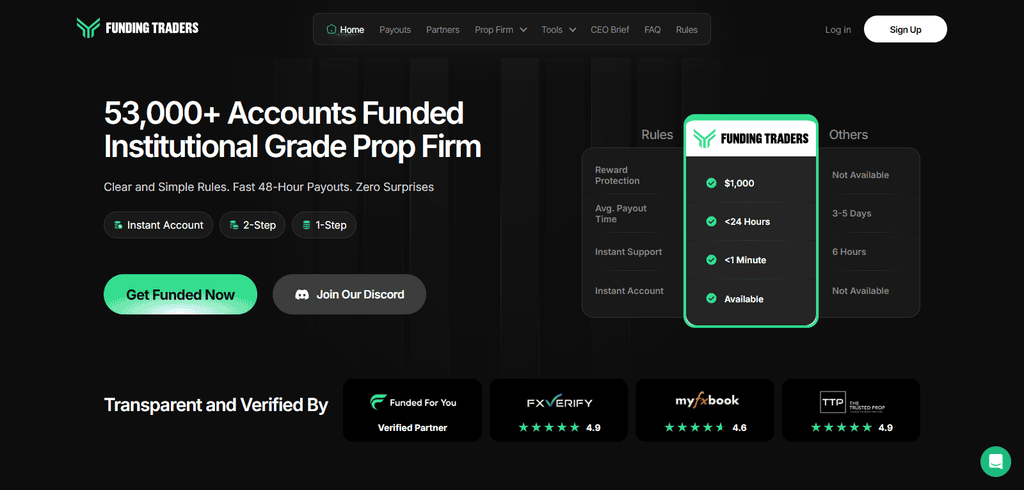
Financial accounts can reach up to $500,000. There are clear and frequent solvency checks. Transactions are processed in 72 hours. Funding Traders merges retail accessibility and institutional liquidity and is excellent for traders of any level.
| Feature | Details |
|---|---|
| Founded | 2020 |
| Fees | $125–$599 evaluation |
| Profit Split | 80–90% |
| Platforms | MT4, MT5, cTrader |
| Account Sizes | Up to $500K |
| Liquidity | Institutional aggregation |
| Execution Speed | Reliable |
| Payouts | Within 72 hours |
| Compliance | Solvency checks |
| Focus | Retail + institutional access |
Funding Traders Pros & Cons
Pros
- Provides multiple funded-account options
- Different challenge structures are available
- Offers various account sizes
- Provides profit-sharing opportunities
- Risk rules are defined for each program
Cons
- Conditions vary across account models
- Drawdown rules require close monitoring
- Some trading methods may be restricted
- Payout conditions need careful review
- Program specifications can change
10. Maven Prop Capital
Founded in 2025 in London, Maven Prop Capital offers multi‑asset trading across the world. Evaluation fees start at £199. Profit splits range from 85 to 90%, which are credited monthly. MT5 and internal analytics software are the only trading platforms offered.
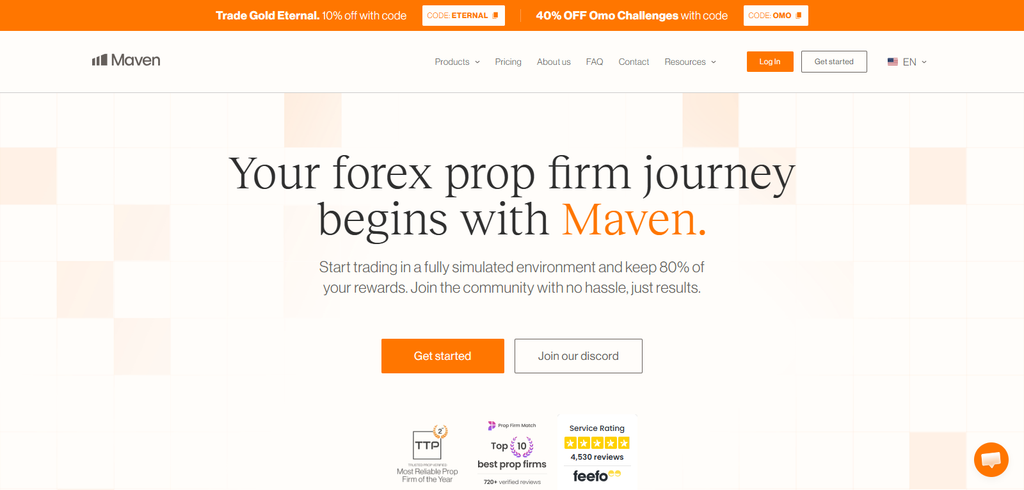
Liquidity aggregation offers access to top tiers of Execution in Forex, Stocks, and Commodities. Accounts go up to $1M, and are regulated within the standards of the FCA. Transactions are processed in under 48 hours. Maven’s global institutional liquidity, along with its compliance, makes it an excellent choice for professional traders.
| Feature | Details |
|---|---|
| Founded | 2025, London |
| Fees | £199+ evaluation |
| Profit Split | 85–90% |
| Platforms | MT5, proprietary analytics |
| Account Sizes | Up to $1M |
| Liquidity | Tier‑1 aggregation |
| Execution Speed | FCA‑aligned protocols |
| Payouts | Within 48 hours |
| Compliance | UK regulation |
| Focus | Global multi‑asset trading |
Maven Prop Capital Pros & Cons
Pros
- Offers structured funded-account programs
- Multiple account configurations
- Defined evaluation requirements
- Provides profit-sharing opportunities
- Designed for traders seeking external capital
Cons
- Spread conditions can affect trading costs
- Rules vary across available programs
- Drawdown limits require disciplined trading
- Some strategies may face restrictions
- Traders should verify current payout terms before joining
Conclusion
As we wrap up, we found 2026’s 10 best prop firms utilizing liquidity aggregation: FTMO, Topstep, Funded Engineer, E8 Funding, The 5%ers, Apex Trader Funding, FundedNext, Glide Trading, Funding Traders and Maven Prop Capital. Each firm offers different assets to the trading community.
Platforms from deep institutional liquidity, competitive fee structures, and profit splits are from transparent and reliable MT4 / MT5 / cTrader or futures structures.
Their models for scaling accounts offer multi-thousand or multi-million dollar allocations to traders at all levels. Liquidity aggregation ensures faster fills with less slippage, thus offering more fair trading conditions, and make them the best firms for prop trading.
FAQ
Liquidity aggregation combines pricing and available liquidity from multiple liquidity providers to support competitive spreads and efficient trade execution.
Prop firms can use aggregated liquidity to access multiple market sources, improve execution infrastructure, and manage trading liquidity more efficiently.
It can influence spreads, execution speed, available liquidity, slippage, and the overall quality of trade execution.
No. Prop firms can use different execution and liquidity arrangements depending on their technology, brokers, liquidity providers, and trading model.
It can help provide competitive pricing by combining quotes from multiple sources, but actual spreads depend on market conditions and the firm’s setup.
