

In this article, I will highlight the Best AI-Powered Onboarding and KYC Verification Providers for Regulated Prop Firms. These providers assist trade companies with client onboarding, identity fraud prevention, and international compliance.
Using Artificial Intelligence (AI), biometric verification, and automated Anti-Money Laundering (AML) screening, these platforms create the quickest, safest, and most secure onboarding experience that meets full compliance for proprietary trading firms.
Key Points & Best AI-Powered Onboarding and KYC Verification Providers for Regulated Prop Firms
| AI-Powered KYC Provider | Explanation |
|---|---|
| Sumsub | Automates identity verification, AML screening, and fraud prevention for prop firms. |
| Veriff | Provides AI-driven identity checks with fast onboarding and document authentication globally. |
| Onfido | Combines biometric verification and document analysis to reduce onboarding fraud risks. |
| Trulioo | Offers global identity verification covering businesses and individuals across multiple countries. |
| Jumio | Delivers AI-powered identity proofing with facial recognition and compliance monitoring tools. |
| Shufti Pro | Enables real-time KYC verification with advanced biometric and document scanning technologies. |
| Persona | Provides customizable identity workflows supporting compliance and frictionless customer onboarding experiences. |
| IDnow | Offers secure digital identity verification and video identification for regulated firms. |
| AU10TIX | Uses machine learning for document authentication and preventing identity fraud attempts. |
| ComplyCube | Delivers automated KYC, AML checks, and biometric verification for financial platforms. |
10 Best AI-Powered Onboarding and KYC Verification Providers for Regulated Prop Firms
1. Sumsub
Thanks to its comprehensive compliance ecosystem, Sumsub has earned the trust of many AI-driven onboarding systems and KYC solutions. It has become especially popular among regulated proprietary trading firms.
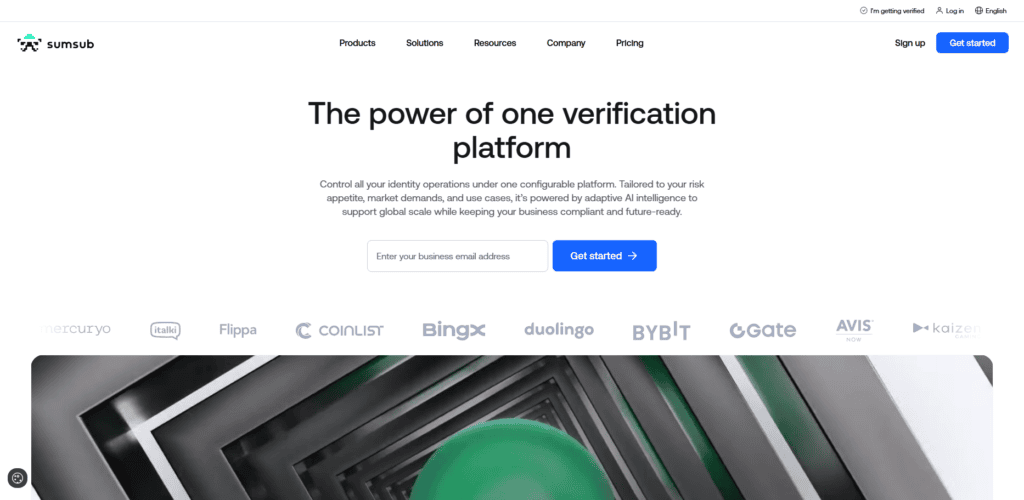
Its user-friendly dashboard integrates identity verification, ATS, transaction monitoring, and prevention of fraudulent activities, and firms can now onboarding traders from many countries with the system. Its AI engine has the capability of detecting document forgery, synthetic identities, and dubious activities.
Sumsub also introduced ongoing compliance monitoring, so traders can be monitored for compliance after the onboarding. For firms that deal with international clients and have to meet stringent regulations, Sumsub offers a flexible and cost-effective solution for optimization of manual verification.
Sumsub – Pros & Cons
| Pros | Cons |
|---|---|
| All-in-one KYC, AML, and transaction monitoring platform. | Premium features can increase overall implementation costs. |
| Excellent fraud detection using AI and behavioral analytics. | Initial setup may require technical integration support. |
| Supports onboarding customers from numerous countries worldwide. | Smaller firms may not need every compliance module. |
| Continuous monitoring ensures ongoing regulatory compliance. | Custom workflows can take time to configure properly. |
| Highly scalable for rapidly growing prop trading firms. | Advanced reporting features have a learning curve. |
2. Veriff
Veriff is one of the top-rated verification systems on the market and for good reason. With its AI document authentication and international verification, many firms detail the use of Veriff’s system to enhance their customer onboarding from multiple countries.
With routed thousands of government identity documents, Veriff makes it easy for firms to have a multitude of international users. Firm that focus on prop trading operations can greatly benefit from.
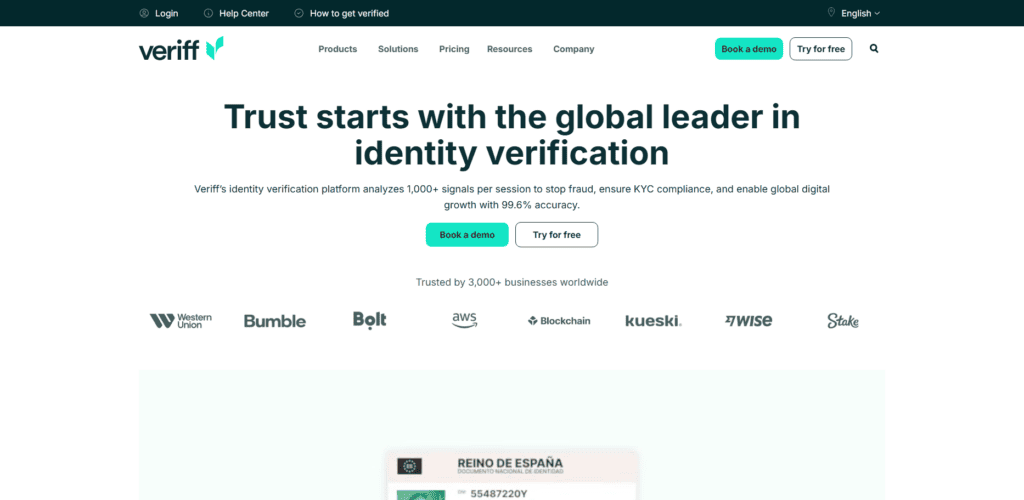
Veriff’s automated onboarding as it allows firms to verify users and even score a tradeable account within minutes all whilst providing a great customer experience.
To assist regulated trading firms further, Veriff provides systems and infrastructure for detecting low-risk, suspicious applicants, and contracts.
Veriff – Pros & Cons
| Pros | Cons |
|---|---|
| Verifies thousands of identity documents globally. | Pricing may be expensive for startups and small firms. |
| Fast onboarding process improves customer conversion rates. | Limited customization compared with some competitors. |
| Strong biometric verification and fraud analytics capabilities. | Advanced features may require enterprise subscription plans. |
| User-friendly API enables smooth platform integrations. | Verification accuracy can vary with poor-quality documents. |
| Real-time risk indicators help identify suspicious traders. | Some regional documents may require additional checks. |
3. Onfido
Automated biometric and document verification technologies enable Onfido to provide highly secure onboarding for regulated financial institutions and prop firms. The platform uses facial matching with liveness detection to verify users’ presence in the real world.
Onfido’s AI algorithms detect document manipulation and synthetic identity construction to mitigate the impact of fraud. Online prop firms benefit from Onfido’s branch-less verification.

Furthermore, the provider’s automated compliance features meet the constantly changing regulatory requirements of various jurisdictions. Onfido is a valuable tool for prop firms because it provides a seamless onboarding process and minimizes user abandonment during account registration.
Onfido – Pros & Cons
| Pros | Cons |
|---|---|
| Advanced liveness detection prevents identity spoofing attacks. | Higher pricing for businesses with large volumes. |
| Reduces onboarding friction through automated verification. | Some integrations require additional development resources. |
| Excellent document and biometric authentication capabilities. | Manual reviews occasionally increase verification times. |
| Trusted by many fintech and financial institutions. | Enterprise contracts may have minimum volume requirements. |
| Supports regulatory compliance across multiple jurisdictions. | Limited flexibility for highly customized workflows. |
4. Trulioo
Trulioo is a leading global identity verification service. It specializes in the verification of individuals and businesses across a multitude of international data sources. This extended coverage is a beneficial solution for proprietary trading firms that operate across many jurisdictions.

AI at Trulioo cross-references the customer data provided against verified data, as well as lists of sanctioned individuals and politically exposed persons, to assist prop firms in meeting compliance requirements.
Additionally, Trulioo’s API-based infrastructure simplifies the integration of the service to trading and customer management systems. For firms that are expanding their operations internationally, Trulioo is a strong service for maintaining compliance and verifying customer identities at a global scale.
Trulioo – Pros & Cons
| Pros | Cons |
|---|---|
| Extensive global identity and business verification coverage. | Pricing structure can become complex for enterprises. |
| Access to hundreds of trusted international data sources. | Certain databases may have regional limitations. |
| Strong AML and sanctions screening capabilities. | Advanced integrations may require technical expertise. |
| Scalable API infrastructure for global expansion. | Verification costs increase with multiple data checks. |
| Supports both individual and business onboarding. | Reporting interface may feel complex for beginners |
5. Jumio
By putting AI, facial biometrics, and risk analysis together, Jumio has created a unique platform and has positioned itself as a leader in high-end identity verification. Jumio creates compliance solutions for regulated prop firms that incorporate automated anti-money laundering (AML) and fraud detection and analysis.

Jumio captures the live facial image of a trader and compares it to a verified government ID. Jumio’s platform makes sense for prop firms that serve high-value traders because of the platform’s strong security and fraud prevention measures.
Jumio positively impacts the time and resources spent on the onboarding and compliance process by automating many of the compliance tasks.
Jumio – Pros & Cons
| Pros | Cons |
|---|---|
| High-accuracy facial recognition and identity verification. | Premium pricing compared with several competitors. |
| Strong fraud prevention for high-risk accounts. | Some advanced features require additional subscriptions. |
| Comprehensive compliance and AML monitoring tools. | Integration can be challenging for smaller companies. |
| Excellent support for global regulatory requirements. | Verification processing may slow during peak demand. |
| Suitable for institutions handling large transaction values. | Less affordable for early-stage prop firms. |
6. Shufti Pro
Shufti Pro prides itself on providing real-time identity verification by integrating AI and biometric authentication.
Their platform enables verification of documents from all countries and includes facial recognition, liveness detection, and AML. For prop firms, Shufti Pro’s onboarding system has the capability of real-time verification of multiple traders across different countries.

They have strong fraud prevention measures in identifying non-authentic identities and suspicious behavior prior to approving accounts.
Shufti Pro also has customizable verification processes that allow firms to align their compliance processes to both regional regulations and their own internal standards of risk.
Shufti Pro – Pros & Cons
| Pros | Cons |
|---|---|
| Real-time verification delivers extremely fast onboarding. | Customer support response times can occasionally vary. |
| Supports global document verification and biometrics. | Pricing may increase with higher verification volumes. |
| Flexible workflow customization for different regulations. | Some advanced analytics features are limited. |
| Effective fraud detection and AML screening tools. | Smaller firms may require onboarding assistance initially. |
| Easy integration through APIs and SDKs. | Certain niche documents may require manual verification. |
7. Persona
Persona has the most extensive variety of customizable identity workflows in the industry, which means they can be flexibly tailored to suit different business models and different regulatory requirements.
Where other workflows take a one-size-fits-all approach, Persona enables prop firms to design bespoke onboarding pathways that utilize varying verification methods from document checks, to biometrics, to database checks.

Persona’s AI-powered decision engine assists firms in meeting the competing demands of regulatory verification and customer satisfaction by dynamically modulating verification requirements based on a given risk profile.
Coupled with its analytics and fraud detection systems, the adaptability of Persona’s workflows is essential for prop trading firms.
Persona – Pros & Cons
| Pros | Cons |
|---|---|
| Highly customizable onboarding workflows and verification rules. | Configuration can be complex for non-technical teams. |
| Excellent analytics and fraud monitoring capabilities. | Premium customization features increase overall costs. |
| Flexible risk-based verification improves user experience. | Smaller companies may underutilize advanced functions. |
| Integrates with multiple identity and data providers. | Requires planning to optimize workflow performance. |
| Ideal for rapidly scaling prop trading firms. | Setup process may take longer than simpler platforms. |
8. IDnow
As a digital verification provider of identity solutions, IDnow specializes in secure remote onboarding and video identification. By integrating automation with an optional human review, IDnow employs a practical solution that secures both safety and compliance.
For regulated prop firms, IDnow satisfies the requirement of onboarding remote verification of Traders in full compliance with the financial regulations of various jurisdictions. In verification of identity, biometrics, and customer data, IDnow systems utilize an AI-embedded fraud detection.
Video verification adds a further layer of security beyond automation for high risk accounts. For regulated trade firms, the combination of automation and an adequate vetting process is ideal.
IDnow – Pros & Cons
| Pros | Cons |
|---|---|
| Secure video identification for high-risk customer verification. | Video verification can lengthen onboarding processes. |
| Combines automation with optional human reviews. | Services may cost more than fully automated platforms. |
| Strong compliance capabilities for regulated industries. | User experience depends on internet connection quality. |
| Excellent fraud detection and document analysis tools. | Geographic coverage may be smaller than global competitors. |
| Suitable for stringent European regulatory requirements. | Some integrations require specialized technical support. |
9. AU10TIX
Based on machine learning (ML) and advanced document technologies, AU10TIX offers highly accurate identity verification. The platform can efficiently identify executed forged documents, synthetic identity creation, and account takeover, which is helpful for proprietary trading firms that encounter fraudulent online activities.

The automated verification engine can analyze identity documents in a matter of seconds. AU10TIX maintains stringent compliance, and automated verification improves the speed of the document verification process, supporting shorter timeframes for client onboarding.
AU10TIX also includes behavioral analytics and fraud intelligence, which provide firms the ability to view and assess suspicious activities. For regulated prop firms, AU10TIX strikes an appropriate balance of security, compliance, concerns, and operation capability.
AU10TIX – Pros & Cons
| Pros | Cons |
|---|---|
| Exceptional document fraud detection using machine learning. | Pricing information is less transparent publicly. |
| Fast identity verification with automated processing. | Enterprise-focused services may not suit startups. |
| Strong protection against synthetic identity fraud. | Advanced customization can require technical expertise. |
| Behavioral analytics improve fraud risk management. | Smaller firms may find implementation expensive. |
| High verification accuracy for financial institutions. | Limited public documentation compared with competitors. |
10. ComplyCube
ComplyCube is a rapidly evolving RegTech provider that has developed consolidated automated compliance services, including KYC, AML, and biometric verification, in a single platform.
The primary focus of ComplyCube is to assist financial institutions and prop firms simplify and accelerate their compliance registrations while safeguarding the integrity of governing regulations.
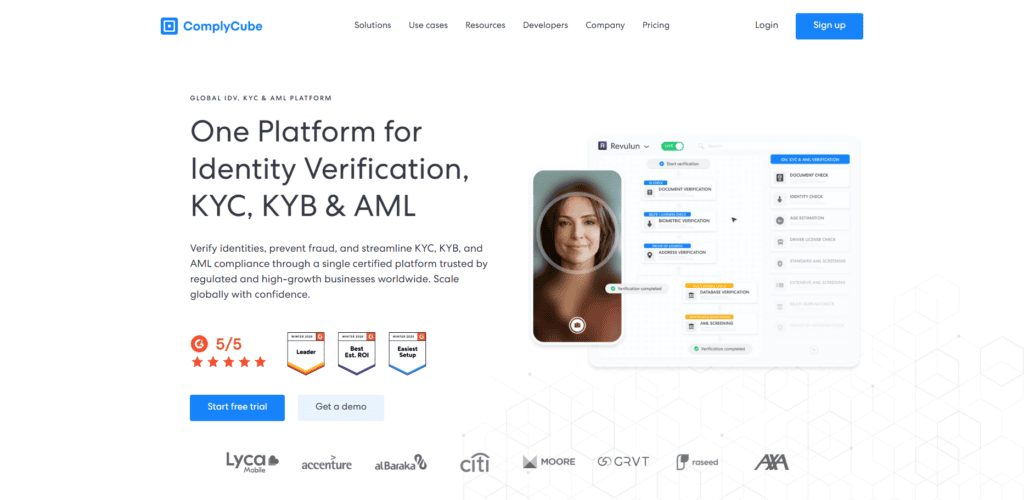
Its AI supports verification of document and facial recognition and provides sanction lists, along with continuous monitoring of the customer.
Due to the modular nature of ComplyCube, it has the flexibility to provide precisely the compliance services its clients wish to use and consumes less resources to embrace compliance.
The platform also includes the capability of real-time risk assessment and fraud detection that supports legitimate business decisions to a higher confidence level of traders.
ComplyCube – Pros & Cons
| Pros | Cons |
|---|---|
| Cost-effective modular compliance and verification platform. | Newer provider with shorter market track record. |
| Offers KYC, AML, and biometric verification tools. | Fewer third-party integrations than established competitors. |
| Real-time risk scoring improves decision-making capabilities. | Global coverage is still expanding in some regions. |
| Flexible pricing suits growing prop trading firms. | Some advanced features continue evolving rapidly. |
| Easy implementation through modern APIs and SDKs. | Brand recognition remains lower than industry leaders. |
How We Choose Best AI-Powered Onboarding and KYC Verification Providers for Regulated Prop Firms
- Compliance Requirements: Use the standards of the prop firm to organize what regulations demand and what they allow.
- Onboarding Speed: Choose companies with fast ID verification and account approval.
- Pricing and Scalability: View prop firm costs and ensure your scalability from future firms.
- Integration Requirements: Check the systems will integrate with your platforms, trading systems and CRMs.
- Fraud Prevention Review: Choose companies with tools to capture identity fraud with suspicious onboarding.
- Global Expansion: Consider companies that address international documents and cross-border compliance.
- Customer Support and Services: Choose companies with fast support and services with reliable sustainment.
Cocnlsuion
In cocnlsuion The choice of the AI-based onboarding and KYC verification system impacts the security, compliance and efficiency of trader onboarding for relevant prop firms. Advanced fraud detection, biometric verification and AML screening are provided by the leading platforms: Sumsub, Veriff, Jumio and Trulioo.
With the correct choice of the system, prop firms are able to reduce compliance risk and enhance user experience among the common business operations in the era of high regulatory demands in the global trading business.
FAQ
It is a platform that uses artificial intelligence to automate identity verification, AML checks, and customer onboarding processes.
They help firms comply with financial regulations, prevent fraud, and onboard legitimate traders securely.
Top providers include Sumsub, Veriff, Onfido, Trulioo, Jumio, Shufti Pro, Persona, IDnow, AU10TIX, and ComplyCube.
AI speeds up document verification, detects fraudulent identities, and reduces manual compliance work.
