


In this article, I talk about top-rated Prop Firm CRM Platforms featuring embedded Risk Mitigation Dashboards. These systems aid proprietary trading firms in stressing the automation of risk management, trader activity, and operational efficiency.
This type of system incorporates real-time analytics, compliance, and exposure tools. This permits prop firms to diminish financial risk, create a more efficient work environment, and implement improved business decisions while trading.
What Is a Risk Mitigation Dashboard in a Prop Firm CRM?
A risk mitigation dashboard built into a prop firm CRM system creates a centralized hub for risk monitoring. This makes the real-time identification, assessment, and tracking of key trading risks easier.
It automatically generates reports and alerts that visualize trading risk indicators, such as account exposure, drawdown, loss limits, rule breaches, and abnormal trading activity.
With these capabilities, risk managers are empowered to act faster to prevent loss, breach of trading policies, and diminish automation and efficiency of trading risk assessment and trader performance evaluation throughout the entire proprietary trading firm.
Key Points & Best Prop Firm CRM Platforms with Built-In Risk Mitigation Dashboards
| Prop Firm CRM Platform | Explanation |
|---|---|
| FX Back Office | Automates client management while tracking exposure and reducing trading risks. |
| UpTrader CRM | Provides analytics dashboards for monitoring trader behavior and risk metrics. |
| B2Core | Integrates risk controls with comprehensive customer relationship management features seamlessly. |
| Skale CRM | Delivers real-time monitoring tools to identify suspicious trading activities early. |
| Trade Soft CRM | Simplifies account administration with built-in compliance and risk tracking systems. |
| Leverate LXCRM | Offers advanced reporting dashboards to control firm-wide operational trading risks. |
| cTrader CRM | Enhances broker management through automated alerts and exposure monitoring capabilities. |
| CloudForex CRM | Combines trader analytics with customizable dashboards for proactive risk management. |
| Brokeree CRM | Supports multi-account supervision and minimizes risks using intelligent automation tools. |
| TFB CRM | Centralizes trader data while improving compliance and mitigating financial exposures. |
10 Best Prop Firm CRM Platforms with Built-In Risk Mitigation Dashboards
1. FX Back Office
A proprietary trading firm Crm that merges automated risk oversight and client administration. The integrated dashboards allow the firms to keep track of account exposure and trading limits, as well as instigate alerts if suspicious behavior is detected on the trading floor.
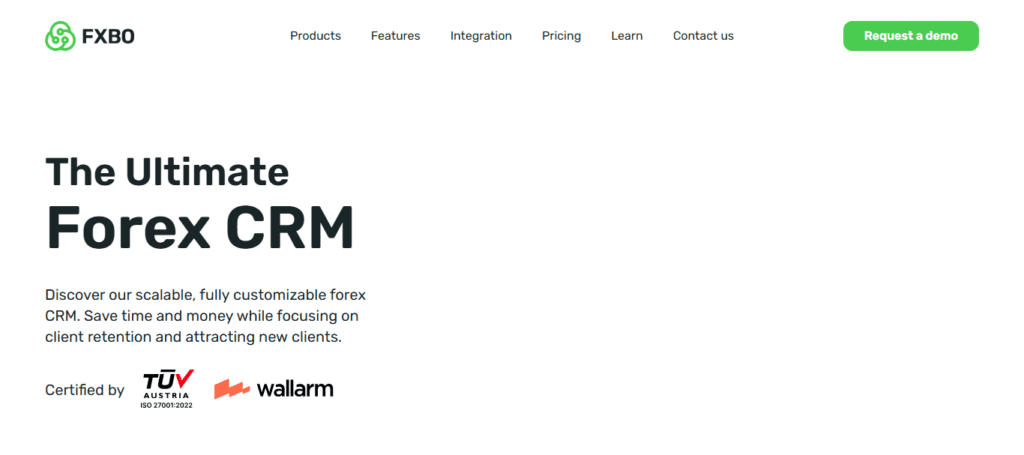
The software includes support for KYC (Know Your Customer) and payment processing. Reports on risk and operational activity are constantly generated. It is time saving and operationally efficient. Thanks to the automated alerts and customizable risk parameters, it is also beneficial for firms that sponsor a large number of funded traders.
FX Back Office (FXBO)
- Pricing: Mid to high (custom enterprise pricing based on users & modules)
- Risk Dashboard: Advanced, real-time, trader exposure and portfolio overview
- Drawdown Tracking: Yes, daily and maximum drawdown tracking
- Rule Automation: Automated trading rules, compliance, and account actions
- KYC: KYC/AML verification system with document management
- API: Yes, full API to MT4/MT5, payment channels, and other tools
FX Back Office Pros & Cons
| Pros | Cons |
|---|---|
| Advanced exposure monitoring and risk dashboards | Higher pricing for smaller prop firms |
| Supports KYC and payment automation | Requires technical setup for customization |
| Real-time alerts for suspicious activities | Limited third-party integrations compared to competitors |
| Detailed reporting and compliance tools | Learning curve for new administrators |
2. UpTrader CRM
UpTrader draws on an analytics engine incorporated into a trader behavior monitoring system. By providing a summary of account activity that is broken down by trading score, profit consistency, and even violations of firm policy, the dashboards provide real time insight.
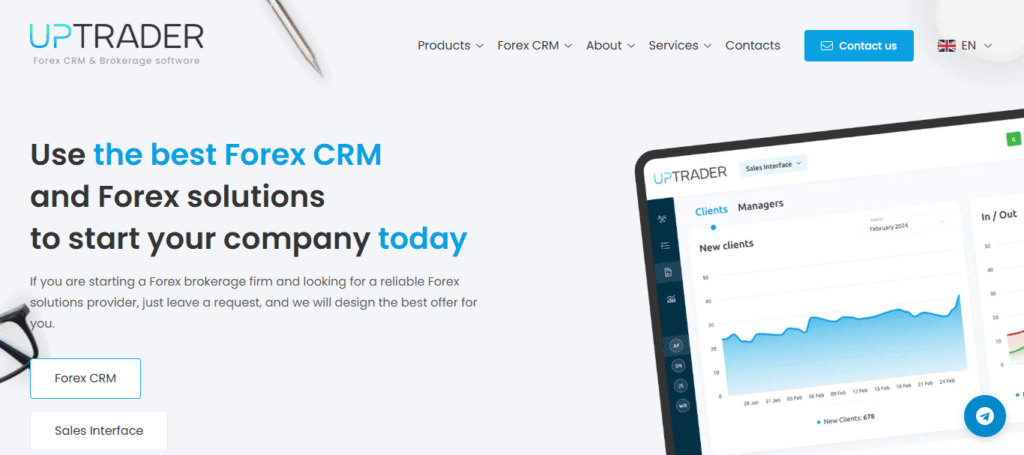
Risk managers may notice the violations and, if necessary, put a stop to the consistently problematic behavior before firm losses occur.
UpTrader boasts comprehensive client segmentation, automated alerts, and an affiliate management system, allowing it to provide an all-in-one solution for firms that are serious about facilitating trader development, while also managing risk.
UpTrader CRM
- Pricing: Mid-range subscription + setup fee (based on number of features)
- Risk Dashboard: Real-time trader performance and risk dashboard
- Drawdown Tracking: Yes, equity-based drawdown tracking
- Rule Automation: Automation of rules, restrictions, and trading conditions
- KYC: KYC with onboarding verification tools
- API: Yes, adjustable API to trading platforms and other services
UpTrader CRM Pros & Cons
| Pros | Cons |
| Powerful analytics and trader behavior tracking | Premium features can increase overall costs |
| Interactive dashboards with real-time metrics | Initial implementation may require expert assistance |
| Includes affiliate and client management tools | Custom modules may need additional development |
| Excellent for scaling funded trader programs | Smaller firms may not use all functionalities |
3. B2Core
B2Core integrates a fully fledged customer relationship management (CRM) system into the risk control environment of a proprietary trading firm. The software allows firms to control the exposure limits of the firm as well as the accounts of the traders.
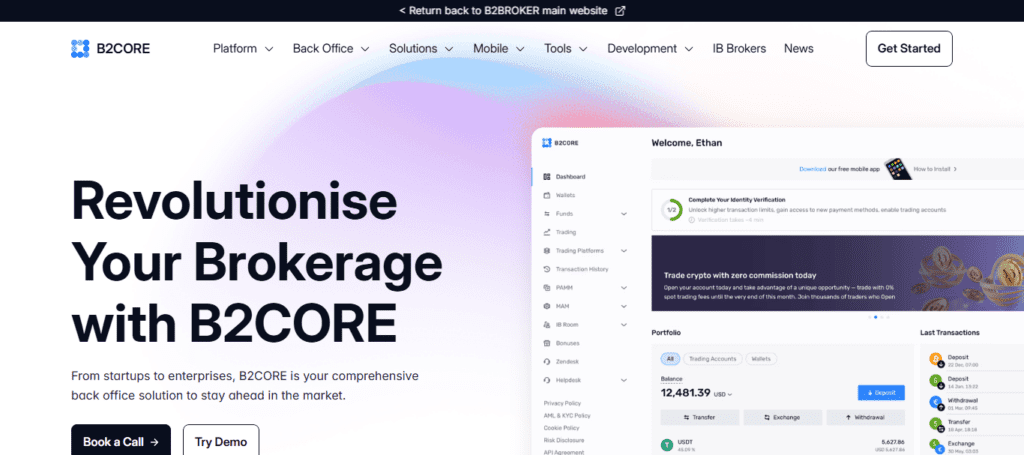
A custom dashboard allows firms to display reports of their choice. The B2Core modular environment allows firms to set trading parameters that are flexible enough to align with the firms own risk appetite. Additionally, B2Core plays well with a majority of trading and payments systems.
B2Core (B2Broker)
- Pricing: Premium (enterprise-level pricing)
- Risk Dashboard: Multi-account risk and exposure dashboard (highly advanced)
- Drawdown Tracking: Yes, account-level drawdown tracking
- Rule Automation: Automation of compliance, risk rules, and account actions
- KYC: KYC/AML with integrated onboarding
- API: Yes, Brokers, payments, and trading platforms rich API
B2Core Pros & Cons
| Pros | Cons |
| Highly customizable modular architecture | Advanced setup can be time-consuming |
| Integrates with multiple trading platforms | Some features require additional licensing |
| Strong reporting and risk management tools | Can be expensive for startup prop firms |
| Supports numerous payment providers | Extensive features may overwhelm beginners |
4. Skale CRM
Skale CRM is built for trading firms that need to keep an eye on trader activities and risk indicators. The software employs automated systems for tracking suspicious trading behavior, policy violations, and abnormal account performance.
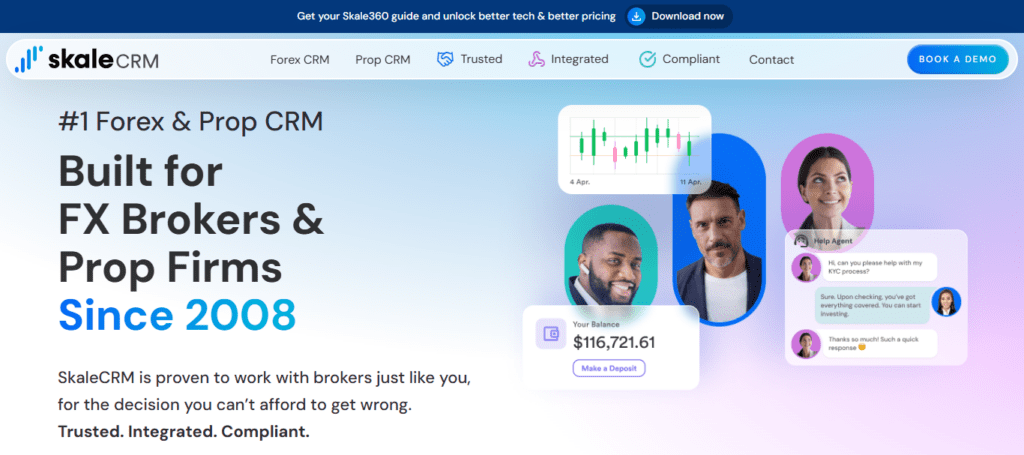
With real-time dashboards showing actionable insights, firms are able to take steps to reduce prospective losses. Flexible reporting and adjustable risk thresholds make Skale CRM useful for prop firms that have as many funded traders as they do, and operate across various markets.
Skale CRM
- Pricing: Mid tier (customized pricing based on brokerage size)
- Risk Dashboard: Trade Soft CRM Portfolio Risk Dashboard offers advanced analytics for risk exposure.
- Drawdown Tracking: Yes, more advanced drawdown control
- Rule Automation: High automation for the setting of trading and compliance rules
- KYC: KYC/AML automated placing and integrated
- API: Yes, integrations with trade servers and other external systems are supported.
Skale CRM Pros & Cons
| Pros | Cons |
| Detects suspicious trading activities quickly | Fewer integrations than larger CRM providers |
| Flexible risk thresholds and reporting options | Smaller user community and support ecosystem |
| Excellent for monitoring funded traders | Some advanced tools require customization |
| Real-time performance tracking capabilities | Limited marketing automation features |
5. Trade Soft CRM
Trade Soft CRM combines risk tracking and compliance tools, simplifying the management of trading operations. Prop firms enjoy a centralized environment where administrators can supervise account activity, validate user identities, and effectively apply trading policies.
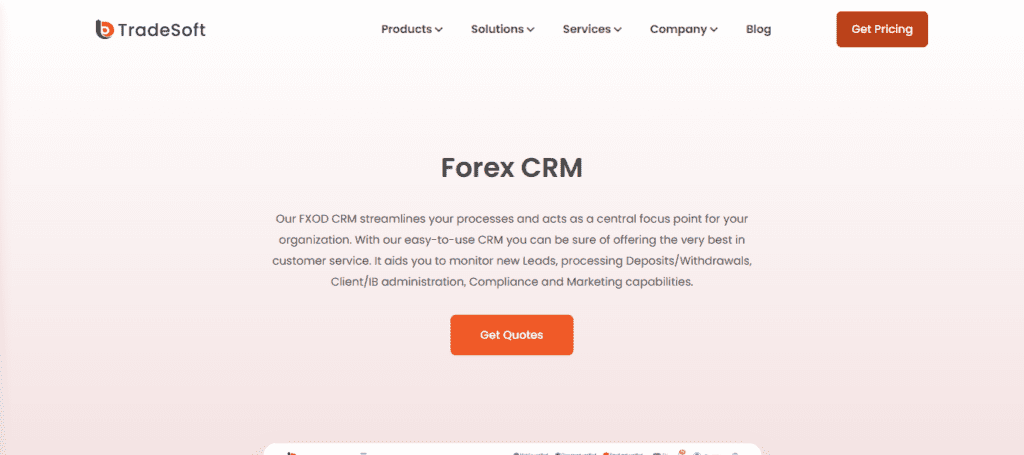
Built-in reporting modules are designed to assist firms in the recognition of threats and the upholding of compliance. Trade Soft CRM employs automated workflows and thorough dashboards to promote operational efficiency. All of the above improve trader oversight and promote effective risk management.
Trade Soft CRM
- Pricing: Mid-Range (custom pricing depending on the brokerage size)
- Risk Dashboard: Advanced analytics dashboard with tracking of risk exposure
- Drawdown Tracking: Yes, strong drawdown control
- Rule Automation: High automation of trading restrictions and compliance rules
- KYC: Integrated KYC/AML verification
- API: Yes, supports integration to trading servers and external systems
Trade Soft CRM Pros & Cons
| Pros | Cons |
| Built-in compliance and verification features | Interface appears less modern than competitors |
| Streamlines account and trader management | Fewer advanced analytics tools available |
| Automated workflows improve efficiency | Limited customization for complex businesses |
| Strong reporting and risk tracking systems | Integration options can be restricti |
6. Leverate LXCRM
Excellent reporting and operational risk management have made Leverate LXCRM a popular choice. The software employs user-friendly dashboards to display real-time updates concerning traders and the status of accounts and exposures.
Managers can set alerts and monitor system health for out-of-norm activity and perform business oversight from the same interface. Additionally, LXCRM combines systems for marketing, sales and customer support, enabling prop firms to balance growth risk and operational transparency and risk control.
Leverate LXCRM
- Pricing: Premium (part of Leverate ecosystem packages)
- Risk Dashboard: Enterprise-level exposure risk monitoring dashboard with live data
- Drawdown Tracking: Yes, advanced drawdown and exposure tracking
- Rule Automation: Strong automation of risk, marketing, and trading rules
- KYC: Built-in compliance and identity verification
- API: Yes, covers full brokerage ecosystem and vast API
Leverate LXCRM Pros & Cons
| Pros | Cons |
| Comprehensive operational risk dashboards | Premium solution with higher implementation costs |
| Integrates sales and customer support functions | Certain modules require separate subscriptions |
| Customizable alerts and reporting tools | Complex for small prop firms with simple needs |
| Strong scalability for growing businesses | Training may be required for full utilization |
7. cTrader CRM
cTrader CRM marries broker management software with sophisticated risk management systems. Automated alerts and exposure monitoring help supervisors respond to anomalous trading patterns, while the system’s analytics assist in the identification and diagnosis of problematic issues.
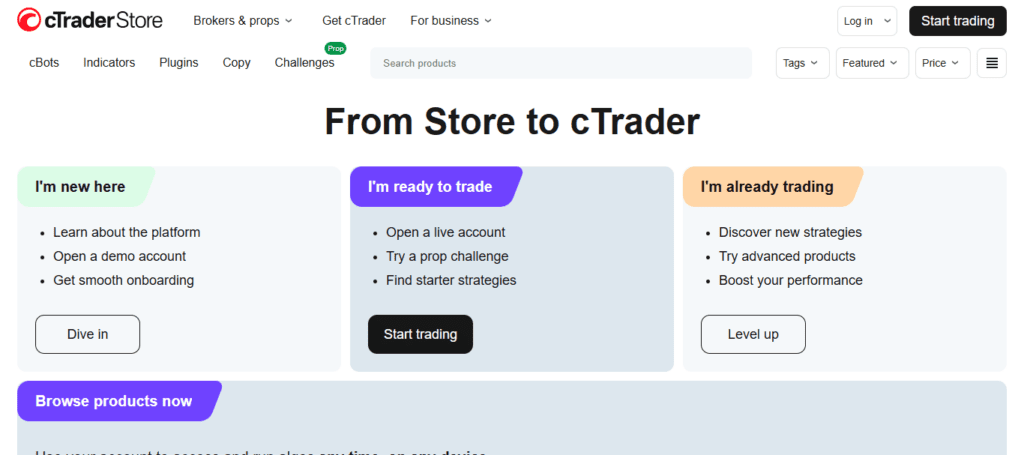
The CRM dashboard provides clarity in trader activity and performance. cTrader CRM offers the means for easy account and communication management. cTrader CRM helps proprietary firms maintain their risk management and control systems while providing proprietary traders with a better and more seamless experience.
cTrader CRM
- Pricing: Platform-based cost (depends on cTrader license/provider)
- Risk Dashboard: Institutional-grade trading analytics dashboard
- Drawdown Tracking: Yes, precise equity and margin tracking
- Rule Automation: Moderate (depends on integration layer)
- KYC: No native in all setups (usually requires third party)
- API: Yes, strong API via cTrader Open API ecosystem
cTrader CRM Pros & Cons
| Pros | Cons |
| User-friendly dashboard and navigation | Works best within the cTrader ecosystem |
| Automated exposure and risk monitoring | Limited integrations with non-cTrader platforms |
| Detailed performance analytics and reporting | Some advanced functions require additional configuration |
| Excellent communication and account management tools | Custom development may increase expens |
8. CloudForex CRM
CloudForex CRM wants to improve risk management systems and control proprietary traders with trader analysis and bespoke trader dashboards. The system helps grow proprietary firms control risk by monitoring key performance indicators and discerning undesirable trading patterns.

Control of those patterns is done by the system’s alerts and dashboards. The system’s infrastructure is completely cloud-based and offers a highly scalable and integrated risk management and centralized trader control system.
CloudForex CRM
- Pricing: Low to mid-range (SaaS subscription model)
- Risk Dashboard: Basic to mid-level risk monitoring dashboard
- Drawdown Tracking: Yes, standard drawdown tracking available
CloudForex CRM Pros & Cons
| Pros | Cons |
| Cloud-based infrastructure with easy accessibility | Smaller brand recognition in the industry |
| Customizable dashboards and trader analytics | Advanced features may require premium plans |
| Automated notifications and reporting systems | Integration options remain relatively limited |
| Suitable for growing prop firms | Fewer educational resources for new users |
9. Brokeree CRM
Brokeree CRM helps proprietary trading firms with the automation of risk control and multi account management. Brokeree CRM helps proprietary firms manage numerous trading accounts at the same time by monitoring exposure through real time dashboards.
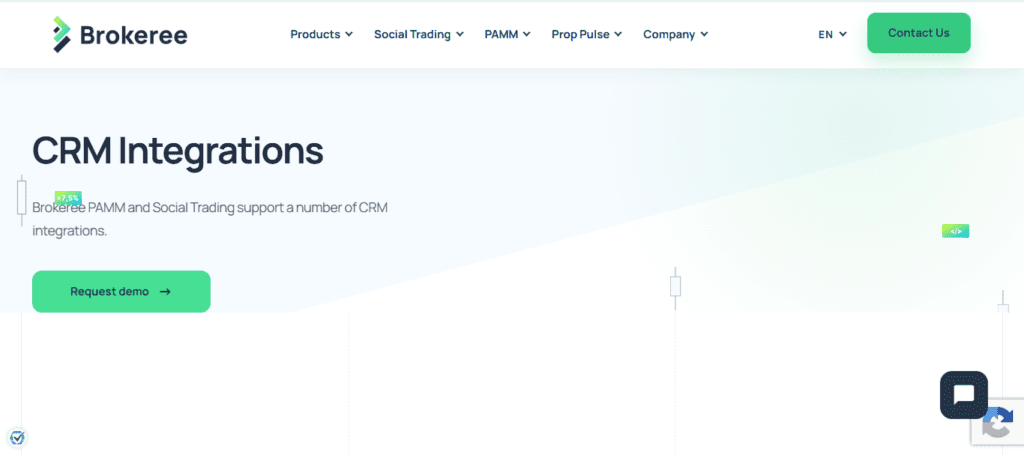
Control of trading accounts is further enhanced through automated reporting and alerts. With its dashboards and reports, trading firms can better manage trading accounts and patterns through the firm’s trading system.
Brokeree CRM
- Pricing: Mid-range to premium (depends on modules like social trading)
- Risk Dashboard: Advanced dashboard especially for copy/social trading risk
- Drawdown Tracking: Yes, supports account- and portfolio-level tracking
- Rule Automation: Strong automation for copy trading and risk controls
- KYC: Available via integration or external providers
- API: Yes, strong API for trading, social trading, and CRM modules
Brokeree CRM Pros & Cons
| Pros | Cons |
| Efficient multi-account supervision capabilities | Setup process can be technically demanding |
| Intelligent automation reduces operational risks | Higher costs for extensive customizations |
| Strong integration with trading ecosystems | User interface may feel complex initially |
| Real-time alerts and reporting features | Smaller firms may not require all functionalities |
10. TFB CRM
TFB CRM combies customer management with compliance and risk mitigation features. It allows proprietary trading firms to understand the risks associated with their financing by conducting analyses on account and activity performance.
Firm administrators can identify unorthodox trading by the use of policy dashboards. The system also provides the capability of creating and modifying company policy documents to improve firm management. The system makes compliance and risk management easy and improves the transparency of the firm’s operations.
TFB CRM (Tools for Brokers)
- Pricing: Premium enterprise pricing (custom quotes)
- Risk Dashboard: Advanced institutional risk monitoring system
- Drawdown Tracking: Yes, drawdown tracking (daily, max, equity-based)
- Rule Automation: Strong automation for full brokerage control
- KYC: Fully integrated KYC/AML compliance system
- API: Yes, extensive, and very flexible API
TFB CRM Pros & Cons
| Pros | Cons |
| Centralized management and compliance oversight | Limited brand awareness compared to major competitors |
| Reduces administrative workload through automation | Fewer third-party integrations available |
| Effective monitoring of financial exposures | Advanced customization may require support assistance |
| Intuitive dashboards and reporting tools | Some reporting features have a learning cur |
How To Choose the Right Prop Firm CRM
- Understand Business Size and Requirements – Understand trader number and functions when choosing prop firm CRM, matching the volume and needs, considering future growth.
- Look for Proper Risk Management – Go for dashboards that include alerts and exposure tracking and also include fraud detection.
- Think About Your Need to Integrate – Make sure CRM will align with trading, payment, and external CRM.
- Check the Pricing and Growth Flexibility – Consider the pricing and make sure the platform with props firm CRM under consideration supports your business goals.
- Look for the Right Customer Support and Training – Assess included trainings and how long props firm CRM will take to be fully implemented and how responsive support will be.
Conclsuion
To sum up, selecting a top-tier prop firm CRM system with automated risk mitigation dashboards can optimize workflows, trader oversight and compliance.
Specifically, risk control and early loss detection, along with anomaly identification, are strengthened with real-time analytics and risk mitigation systems with dashboards available from firms like FX Back Office,
UpTrader CRM and B2Core. By investing in the correct prop firm CRM system, prop firms can improve processes and decision making while building a robust and scalable trading business.
FAQ
A prop firm CRM is software that manages traders, accounts, and business operations.
It is a dashboard that tracks trading risks, exposure, and rule violations.
CRMs automate operations, improve compliance, and enhance trader management efficiency.
FX Back Office, UpTrader CRM, B2Core, and Leverate LXCRM are popular choices.
Yes, advanced CRMs detect suspicious activities and generate automated alerts.
