


This article discusses the leading prop firm liquidity bridges that support automated multi asset routing. Proprietary trading firms utilize these innovative systems to obtain deeper liquidity sources, quicker trade executions, and more advanced order management systems.
We will look at the leading systems, their attributes and advantages as well as the considerations when selecting the optimal liquidity bridge supporting multi asset trading.
What is a prop firm liquidity bridge?
A prop firm liquidity bridge connects prop trading firms to different liquidity providers (i.e., banks, exchanges, market makers) via the internet. It allows firms to automate the routing of their orders, execute trades faster, and provide access to more liquidity across different asset classes
(i.e., forex, crypto, commodities, CFDs, etc.). Since a liquidity bridge combines different liquidity sources, it minimizes the amount of slippage, improves the price, and optimizes the trading experience.
Why Prop Firms Need Advanced Liquidity Bridges
- Faster execution speeds – Significant improvements on the performance of trading due to instantly executed trades that reduce the delay and speed up the process.
- Reduced slippage and better pricing – Attains better prices with lower slippage through the efficient and simultaneous access to various liquidity providers.
- Access to deep institutional liquidity – Increases the market depth available for all global assets and the capability to fill larger trades.
- Improved risk management – Allows greater control on trading risk and the ability to see exposure that is more instantaneous.
- Enhanced Scalability for High Volume Trading – Ability to handle increased trading volumes without the compromise of the speed of execution or the stability of the system.
Key Points & Best Prop Firm Liquidity Bridges Supporting Automated Multi-Asset Routing
| Prop Firm Liquidity Bridge | Explanation |
|---|---|
| OneZero Hub | Connects multiple liquidity providers, enabling fast automated multi-asset trade execution seamlessly. |
| PrimeXM XCore | Delivers low-latency routing and aggregated liquidity across diverse trading asset classes. |
| Centroid Bridge | Provides intelligent order routing with advanced risk management and liquidity aggregation. |
| B2Broker B2CONNECT | Supports automated execution through deep liquidity pools for multiple financial instruments. |
| Leverate LXCapital | Enables brokers to access liquidity and automate multi-asset trade routing efficiently. |
| FXCubic Bridge | Offers customizable liquidity aggregation and smart routing for institutional trading environments. |
| Brokeree Liquidity Bridge | Integrates various providers, ensuring efficient execution and automated asset distribution processes. |
| Tools for Brokers Liquidity Bridge | Facilitates seamless connectivity and optimized routing across numerous trading instruments globally. |
| Match-Trade Technologies Bridge | Provides high-speed execution and consolidated liquidity access for multi-asset trading operations. |
| Integral FX Inside | Combines deep liquidity access with intelligent automated routing across asset classes. |
10 Best Prop Firm Liquidity Bridges Supporting Automated Multi-Asset Routing
1. OneZero Hub
OneZero Hub builds one of the most feature complete liquidity bridges available to a proprietary trading firm today. The platform links brokers and prop firms to many liquidity providers through one infrastructure and enables automated multi-asset routing far easier and faster.

Its cloud-based design facilitates support of forex, CFDs, cryptos, and commodities and provides real-time analytics and smart order execution. Institutional firms prefer OneZero for its flexibility and ability to design routing with the aim of decreasing latency for higher volumes of trades.
| Pros | Cons |
|---|---|
| Connects multiple liquidity providers through one infrastructure. | Premium pricing may be expensive for smaller prop firms. |
| Excellent scalability for high-volume trading operations. | Advanced setup requires technical expertise and configuration. |
| Supports forex, crypto, CFDs, and commodities. | Some features require additional third-party integrations. |
| Real-time analytics improve execution monitoring and decisions. | Enterprise-level features can increase operational costs. |
| Low-latency execution enhances algorithmic trading performance. | Customization may require dedicated IT support teams. |
2. PrimeXM XCore
PrimeXM XCore has attracted many prop firms searching for deep liquidity and ultra-low-latency execution, thanks to its unique features. The bridge integrates liquidity from banks, exchanges, and non-bank providers into one ecosystem and facilitates routing across multiple asset classes.

The architecture of the bridge coupled with its design caters for prop firms with trading strategies that are algorithmic and high-frequency trading. Because the bridge provides sophisticated reporting and risk controls, and integrates flexibly, it has attracted proprietary firms who trade high volumes and have diverse portfolios.
| Pros | Cons |
|---|---|
| Ultra-low latency suitable for high-frequency trading strategies. | Initial implementation costs can be relatively high. |
| Aggregates liquidity from banks and non-bank providers. | Advanced features may overwhelm new brokerage operators. |
| Strong risk management and reporting capabilities. | Requires stable infrastructure for optimal performance. |
| Flexible integrations with numerous trading platforms. | Premium support services may involve additional fees. |
| Reliable execution during volatile market conditions. | Limited affordability for startup proprietary firms. |
3. Centroid Bridge
Centroid Bridge offers proprietary trading firms and brokers intelligent liquidity management. The bridge utilizes sophisticated routing for proprietary trading firms and helps them achieve better pricing, as well as lower the cost of order execution.
The bridge has the capability to support trading across many instruments, even digital assets. Centroid also provides real-time risk and exposure, as well as monitoring and management. Prop trading firms that are looking to boost their trading performance, while still maintaining efficient execution processes, will benefit from the transparent execution of Centroid Bridge.
| Pros | Cons |
|---|---|
| Intelligent routing improves pricing and execution quality. | Smaller liquidity network than some established competitors. |
| Advanced exposure and risk management tools. | Certain integrations require customized development work. |
| Supports multiple asset classes and instruments. | Learning curve for advanced analytical features. |
| Detailed dashboards provide real-time market insights. | Enterprise deployment can be time-consuming. |
| Helps reduce trading and operational costs. | Higher-tier features increase subscription expenses. |
4. B2Broker B2CONNECT
B2Broker’s B2CONNECT platform offers a sophisticated liquidity bridge, providing proprietary trading firms with institutional level liquidity across a variety of asset classes. By consolidating multiple liquidity providers into one system, B2Broker offers firms the ability to access multiple deep liquidity pools with a tight bid/ask.
B2Broker’s system would facilitate the automated routing of trades for Forex, Cryptos, Indices and Commodities at excellent speeds of execution.
Additionally, B2Broker provides risk management tools to firms to deal with their exposure, as well as tailored API solutions. This increases operational efficiency for proprietary trading firms and offers further options for managing their trading environment.
| Pros | Cons |
|---|---|
| Institutional-grade liquidity across multiple asset classes. | Premium solutions may exceed smaller firms’ budgets. |
| Deep liquidity pools improve market execution. | Custom API integration requires technical expertise. |
| Supports forex, crypto, commodities, and indices. | Advanced functionalities may need additional training. |
| Flexible APIs allow extensive customization. | Some features depend on external liquidity providers. |
| Fast execution speeds reduce slippage significantly. | Ongoing maintenance costs can be substantial. |
5. Leverate LXCapital
Leverate LXCapital offers proprietary trading firms and brokers with automated and advanced liquidity solutions the ability to easily access a variety of liquidity streams. For a multi-asset environment, the bridge provides direct access to multiple liquidity providers.
With its advanced framework, LXCapital offers a significant improvement in pricing and latency for an algorithmic trading environment. Further, the advanced liquidity framework provides proprietary trading firms the ability to trade in a variety of asset classes, along with the tools to create a flexible trading framework.
| Pros | Cons |
|---|---|
| Provides diversified liquidity provider connections. | Fewer customization options than some competitors. |
| Improves pricing accuracy for automated strategies. | Smaller ecosystem compared with larger liquidity bridges. |
| Offers comprehensive reporting and analytics tools. | Premium services may involve additional charges. |
| Efficient multi-asset order routing capabilities. | Certain integrations require technical assistance. |
| Suitable for scalable proprietary trading operations. | Limited advanced features for ultra-high-frequency traders. |
6. FXCubic Bridge
FXCubic Bridge possesses one of the most advanced frameworks for liquidity aggregation and smart order routing. The system provides proprietary trading firms the ability to connect to a variety of liquidity streams and automatically execute trades at the best available prices.

FXCubic also provides advanced analytics and risk management tools. Its flexibility provides a firm the ability to customize and control their framework for liquidity and trade execution the firm’s particular trading requirements.
| Pros | Cons |
|---|---|
| Highly customizable liquidity aggregation settings. | Configuration complexity may challenge inexperienced teams. |
| Smart routing improves execution and pricing efficiency. | Premium features increase implementation costs. |
| Supports forex, crypto, and CFD trading. | Smaller firms may underutilize advanced functionalities. |
| Advanced analytics aid strategic decision-making. | Technical support requirements can increase expenses. |
| Flexible architecture suits various trading strategies. | Integration process can be time intensive. |
7. Brokeree Liquidity Bridge
Brokeree Liquidity Bridge provides an automated execution environment for trading platforms and liquidity providers. This solution benefits proprietary firms using Brokeree to diversify their liquidity and optimize the distribution of their orders.
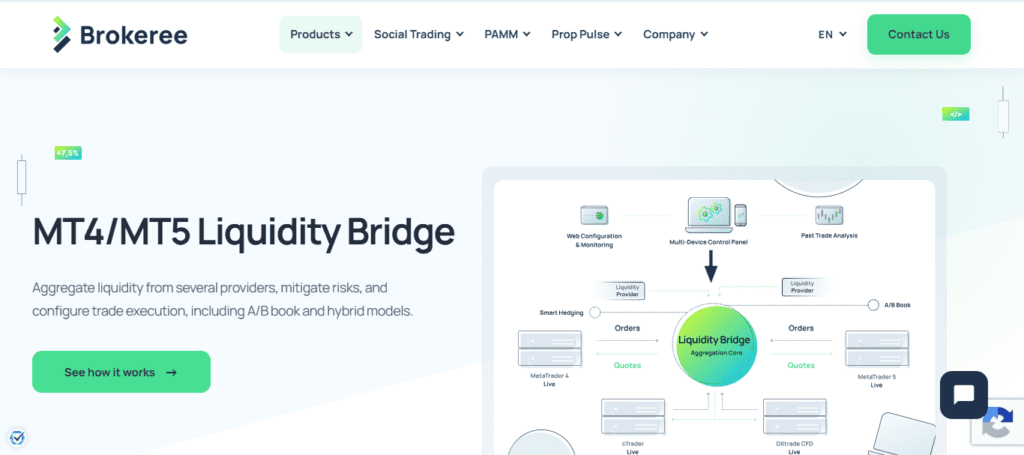
It offers execution management, the ability to monitor orders as they are received, and advanced integration. The bridge allows firms to reduce operational strain and ensure the stability of their trading operations, even during periods of heightened market activity and volatility.
| Pros | Cons |
|---|---|
| Simplifies connections with multiple liquidity providers. | Limited institutional features compared to larger platforms. |
| Enhances automated execution and order distribution. | May require third-party tools for advanced analytics. |
| Reduces operational complexity significantly. | Fewer customization options for large enterprises. |
| Performs reliably during volatile market conditions. | Advanced integrations can require technical expertise. |
| Supports efficient multi-asset trading environments. | Scalability may be limited for very large firms. |
8. Tools for Brokers Liquidity Bridge
Tools for Brokers Liquidity Bridge provides a proposition of flexible infrastructure for proprietary trading firms to utilize multiple liquidity providers via a single gateway. The bridge focuses on optimum order routing, enhanced speed of execution, and optimal order pricing across multiple asset classes
Whilst allowing integration to leading trading platforms, and offers performance metrics along with risk management. These offer the proprietary trading firm automation of trading while retaining quality of execution, thus it is a preferred solution for many.
| Pros | Cons |
|---|---|
| Flexible infrastructure supports multiple providers efficiently. | Some advanced modules require additional licensing fees. |
| Optimizes routing and execution quality. | Smaller liquidity ecosystem than major competitors. |
| Seamless integration with popular trading platforms. | Configuration may require experienced administrators. |
| Detailed analytics improve trading oversight. | Limited customization in certain deployment scenarios. |
| Strong risk management capabilities included. | Customer support responsiveness varies by package. |
9. Match-Trade Technologies Bridge
Match-Trade Technologies Bridge provides a modern proprietary trading system with liquidity aggregation and automated routing, along with a broad range of tradeable assets including forex, cryptocurrencies, indices, and CFDs.

A proprietary firm can manage all its trading from one system of infrastructure. The bridge offers an advanced matching engine and low latency to further system the concern of slippage with trade execution. The bridge also offers risk management and a broad range of reporting which help proprietary firms manage their competitive edge with ease.
| Pros | Cons |
|---|---|
| High-speed execution minimizes trading slippage. | Enterprise deployment can be relatively expensive. |
| Supports diversified multi-asset trading portfolios. | Advanced features require technical knowledge. |
| Advanced matching engine improves execution efficiency. | Smaller firms may not need all functionalities. |
| Comprehensive reporting and risk management tools. | Integration complexity can increase setup timelines. |
| Suitable for modern proprietary trading firms. | Premium support options may incur extra costs. |
10. Integrated FX
This product is an intelligent liquidity bridge that fuses together institutional liquidity and advanced multi-asset routing. Because it supports automated execution for Forex, precious metals, and CFDs, it works with multiple global liquidity providers.
Using advanced technology, firms can set their execution rules and adjust trading to their performance and/or the condition of the market. The bridge offers analytics, risk management, and reporting functions. Because of all of this, it is ideal for prop firms who need liquidity management systems that are readily scalable and efficient.
| Pros | Cons |
|---|---|
| Provides access to deep institutional liquidity pools. | Higher pricing targets institutional clients primarily. |
| Intelligent routing optimizes execution performance. | Complex setup requires specialized technical expertise. |
| Supports forex, metals, and CFDs. | Not ideal for very small prop firms. |
| Advanced analytics and reporting capabilities. | Some integrations need custom development resources. |
| Highly scalable for large trading operations. | Ongoing maintenance and support costs can be significant. |
Our Criteria for the 10 Best Prop Firm Liquidity Bridges Supporting Automated Multi-Asset Routing
We described each Prop Firm liquidity bridge based on these key criteria:
- Speed of Execution – Bridges needed ultra-low latency and fast order processing.
- Depth of Liquidity – We only selected bridges that connected to multiple institutional liquidity providers.
- Support of Multi-Assets – Bridges that supported FX, crypto, CFDs, and commodities were chosen.
- Smart Order Routing – We selected bridges with advanced automated routing and liquidity aggregation.
- Risk Management – Bridges that offered real-time monitoring, exposure, and reporting were chosen.
- Scalability – Bridges that efficiently scaled to high trading volumes were valued.
- Integration with Other Platforms – Bridges that easily connected to primary trading platforms and their APIs were preferred.
- Reliability and Uptime – Bridges with minimal infrastructure and downtime were preferred.
- Flexibility – Bridges with the ability to route and set execution preferences were preferred.
- Reputation in the Industry – Bridges with higher adoption in the markets and more institutional clients and credible bridges were preferred.
Conclsuion
In conclusion, the best prop firm liquidity bridges that support automated multi-asset routing help proprietary trading firms access deeper liquidity, execute trades faster, and get better pricing across more markets.
OneZero Hub, PrimeXM XCore, and Integral FX Inside, for example, have sophisticated routing as well as risk management and scalability features.
Each proprietary trading firm must assess the liquidity needs that stem from their trading volume, the coverage of trading assets, and the customizations of systems that proprietary trading firm wishes to use to help the firm grow.
FAQ
It is the process of automatically directing orders across forex, crypto, commodities, and other assets to the best liquidity source.
PrimeXM XCore and OneZero Hub are widely recognized for ultra-low-latency execution capabilities.
Yes, many platforms support cryptocurrencies alongside forex, CFDs, indices, and commodities.
They aggregate multiple providers and execute trades at competitive prices and tighter spreads.
Yes, they are specifically designed to support automated and high-frequency trading strategies.
