

In this article, I will explain how prop firms can accept cryptocurrency payments and what the process looks like to implement cryptocurrency payment solutions.
I will cover crypto payment gateways, wallet configurations, security and safety, compliance and regulations, and the advantages to accepting digital currency. Prop firms can use this article to implement quicker, safer, and more global payment solutions to traders.
What Are Crypto Payments for a Prop Firm?
Payments for crypto prop firms involve accepting crypto like BTC, ETH, USDT, etc. as payment for trading challenges and evaluation and funded account fees and payouts. Crypto prop firms do not have to exclusively depend on payment processors, banks, and card processors.

They will place a crypto payment gateway or a prop trading crypto payment wallet on their site and will receive crypto payments directly on the blockchain.
This will enhance a faster system with lower costs and greater accessibility for users, especially those who are unable to use a bank to make a transfer. This also increases user security and further diminishes the risk of a chargeback. All of these systems help explain the growing nature of prop payments.
How to Accept Crypto Payments for a Prop Firm
Step 1: Select a Crypto Payment Gateway
Some of the most common crypto payment processors are NOWPayments, CoinPayments, and Coinbase Commerce. Using these processors, you are able to accept several different cryptocurrencies (BTC, ETH, USDT, etc.) and you do not need to worry about wallet security.

Example: A prop firm uses NOWPayments to start accepting USDT (TRC20) for their evaluation fees.
Step 2: Make a Business Account
Complete the prop firm’s registration process on the payment gateway and make sure you complete the KYB (Know Your Business) process. Then, set up a payout crypto wallet or bank account.
Step 3: Obtain API Keys
Ready payment gateways will provide you with API Keys and relevant documentation for you to accept crypto payments.
Step 4: Implement the Payment Gateway on Your Website
The checkout page on your site will now have a “Pay with Crypto” option. Once a trader chooses that option, a payment processor will generate a unique wallet address or a QR code for that specific transaction.
Example: A trader seeking a funded challenge buying a $500 challenge selects “Pay with USDT” → system creates a one-time deposit address → trader sends funds via Binance/Trust Wallet
Step 5: Payment Confirmation on the Blockchain
The gateway observes the blockchain and confirms payment once the order has 1-3 confirmations (the usual for USDT/TRC20 transactions). The system will automatically mark the order as “Paid.”
Step 6: Auto-Activate Trader Account
Once the payment has been confirmed, integrate the gateway’s webhook/API to your CRM/trading account to automatically activate the trader’s evaluation account. This eliminates the need for any manual work.
Step 7: Process All Crypto Trader Payouts
You can choose to either manually or automatically withdraw the trader’s payout to the wallet address the trader provided after verifying their identity.
Step 8: Stay Compliant, While Retaining All Transaction Records
Keep accounting records pertaining to all transactions along with AML/KYC verification for large trader payouts. It is best to hire a compliance specialist for assistance with your region’s regulations for crypto transactions.
Why Should Prop Firms Accept Crypto Payments in 2026?
Attracting Global Traders
- Because of their decentralized nature, prop firms can accept traders from all nations using crypto payments.
- Digital assets enable traders to pay challenge fees from anywhere in the world.
Speedy Payment Processing
- Cryptocurrency transactions are much faster than traditional bank transfers.
- Prop firms enable faster deposits, refunds, and payouts to traders.
Cut Transaction Costs
- The need for expensive international banking is eliminated using crypto payments.
- Prop firms save costly payment processing fees.
Payment Anytime
- All banking systems rely on traditional banking hours, while cryptocurrency networks do not.
- Payments can be made by traders at any time.
Enhanced Trader Experience
- Modern traders appreciate the flexibility crypto payments provide.
- Traders can select their preferred payment choice for challenge fee and payout.
Instant International Payouts
- Bank processing times slow the payment of trader profits, an issue solved with the near-instant borderless nature of crypto.
Reduced Concerns for Banking System
- With crypto payments, bank delays, currency conversion, and regional constraint become irrelevant.
- Prop firms are provided an alternative payment system.
Edge Over Competitors
- Competing prop firms will struggle to attract crypto traders and international users.
Use of Stablecoins for Payment
- Predictable transactions will be made using stable assets, while volatility concerns are eliminated with the use of stablecoins like USDT and USDC.
Refunds and Crypto Payments
| Aspect | Details |
|---|---|
| Reversibility | Crypto transactions are irreversible on the blockchain — refunds can’t be auto-processed like card payments; they require a manual return transaction. |
| Refund Method | Refunds must be manually sent back to the trader’s original wallet address in the same or equivalent cryptocurrency. |
| Price Volatility Risk | If crypto value fluctuates between payment and refund, the refunded amount (in fiat terms) may differ from the original payment. |
| Refund Currency | Firms may refund in the same crypto received, an equivalent stablecoin (USDT/USDC), or convert to fiat — policy should be clearly stated upfront. |
| Processing Time | Refunds depend on blockchain confirmation times — typically minutes for stablecoins (TRC20/Solana), longer for BTC. |
| Transaction Fees | Network fees for the refund transaction are usually borne by the firm, not deducted from the trader’s refund amount. |
| Wrong Address Errors | If a trader provides an incorrect refund wallet address, funds may be permanently lost — address verification is critical. |
| No Chargeback Option | Unlike card payments, traders cannot dispute or reverse crypto payments through a bank — refunds must be firm-initiated. |
| Refund Policy Documentation | Prop firms should clearly outline refund eligibility, processing time, and method in their Terms & Conditions to avoid disputes. |
| Partial Refunds | Technically possible but requires manual calculation and processing since blockchain transactions don’t support automatic partial reversals. |
| KYC Verification for Refunds | Larger refunds may require additional identity verification to prevent fraud or money laundering through refund requests. |
| Gateway Support | Some crypto payment gateways (e.g., BitPay, CoinGate) offer built-in refund tools to simplify the process for merchants. |
Key Benefits of Accepting Crypto Payments for Prop Firms
Faster Transactions – Traditional bank payments can take 1–5 business days while crypto payments typically settle in minutes.
Low Transaction Fees – High transaction volume businesses typically pay credit card processors and banks significant fees. Since crypto payment gateways charge lower fees, prop firms enjoy savings.
Global Accessibility – Many countries have banking restrictions for certain currencies. Prop firms can accept crypto payments and easily expand their customer base to traders in those countries.
No Chargebacks – Card payments can be reversed, causing a chargeback for the business. Avoiding disputes and the potential for chargebacks is another benefit of accepting only crypto payments.
Enhanced Privacy – Since less information is required for crypto payments, prop firms can appeal to traders who value privacy, as they often require less personal or financial info.
Payments Anytime – Since crypto payments are not restricted by bank holiday or business hours, payments can be received and withdrawals can happen at any time.
Targets the Right Audience – Active traders already hold a significant amount of crypto making this payment method the most convenient.
Cross-Border Payments Made Easy – Traditional currency payment methods often require currency conversion and complicated international wire transfers.
Improved Cash Flow – Prop firms needing access to operational funds quickly rely on the faster settlement of crypto payments.
Competitive Edge – Currently, only a small percentage of prop firms accept crypto payments. Firms that do will attract more customers faster than those who rely only on traditional payments.
Types of Cryptocurrencies Prop Firms Can Accept
| Cryptocurrency | Ticker | Network(s) Commonly Used | Why It’s Popular for Prop Firms |
|---|---|---|---|
| Bitcoin | BTC | Bitcoin Network, Lightning Network | Most recognized and trusted cryptocurrency; widely accepted globally |
| Ethereum | ETH | ERC20 (Ethereum Network) | Popular among traders; fast smart contract-based transactions |
| Tether | USDT | TRC20 (Tron), ERC20 (Ethereum), BEP20 (BNB Chain) | Stablecoin pegged to USD; avoids price volatility, most preferred for fees/payouts |
| USD Coin | USDC | ERC20, Solana, Polygon | Regulated stablecoin; trusted for transparency and audits |
| Binance Coin | BNB | BEP20 (BNB Smart Chain) | Low transaction fees; popular with Binance-based traders |
| Litecoin | LTC | Litecoin Network | Faster block confirmation than Bitcoin; low fees |
| Tron | TRX | TRC20 Network | Extremely low fees; often used for USDT transfers |
| Solana | SOL | Solana Network | Very fast and low-cost transactions |
| Dogecoin | DOGE | Dogecoin Network | Popular among retail traders; easy accessibility |
| Ripple | XRP | XRP Ledger | Fast cross-border settlement; low transaction costs |
Best 5 Crypto Payment Gateways for Prop Firms in 2026
1. NOWPayments
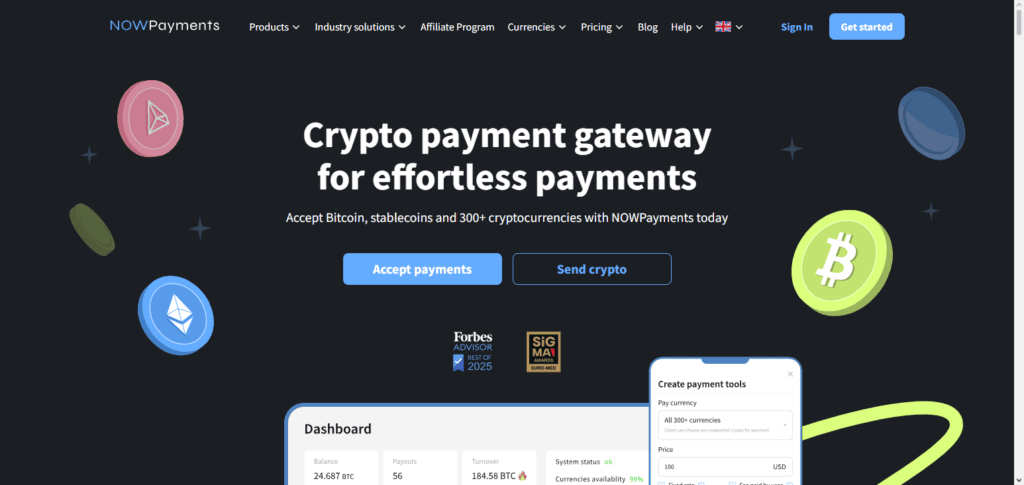
Gateway with no custody and support for 75+ cryptos. Coin auto-conversion helps avoid prop firms being stuck with a single crypto. Fast set up and no heavy compliance means great for SMEs and agile firms.
2. Coinbase Commerce (Onchain Payments)
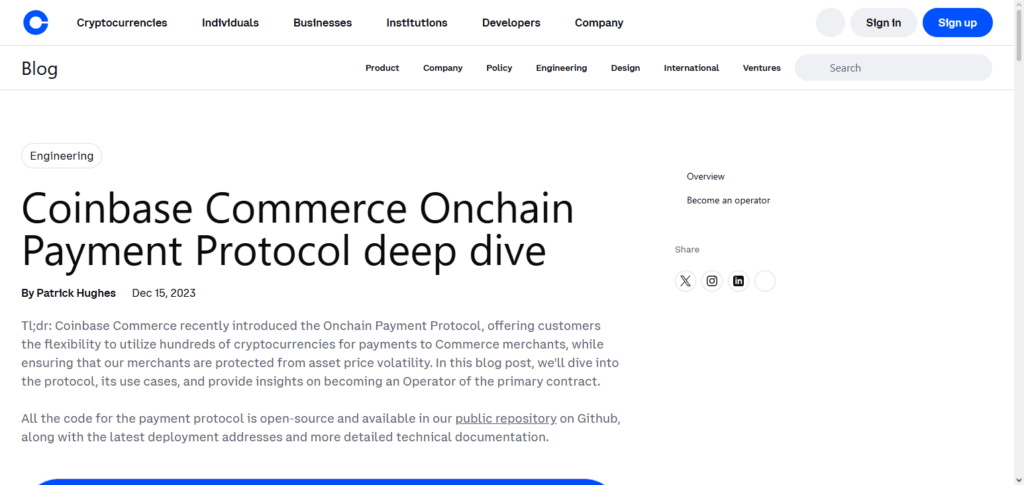
1% flat fee for stablecoin check out. Native plugins on major platforms. Buyers can pay with USDC, USDT, DAI, and PYUSD across Base, Eth, Polygon, Sol, Arbitrum, or Optimism. Good for firms that want a trusted, recognized brand.
3. BitPay
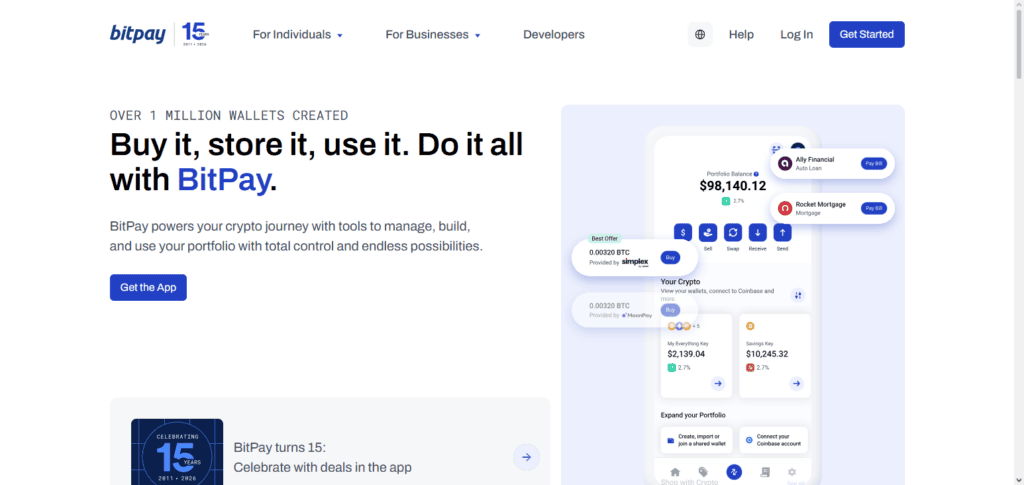
Oldest crypto payment processor, 2011, and with lots of enterprise experience. Added native USDC support across 6 chains. Good for firms that want reliability.
4. CoinsPaid

Based in Estonia and specializes in high volume markets like Gaming or Forex. A natural for prop trading firms.
5. Triple-A
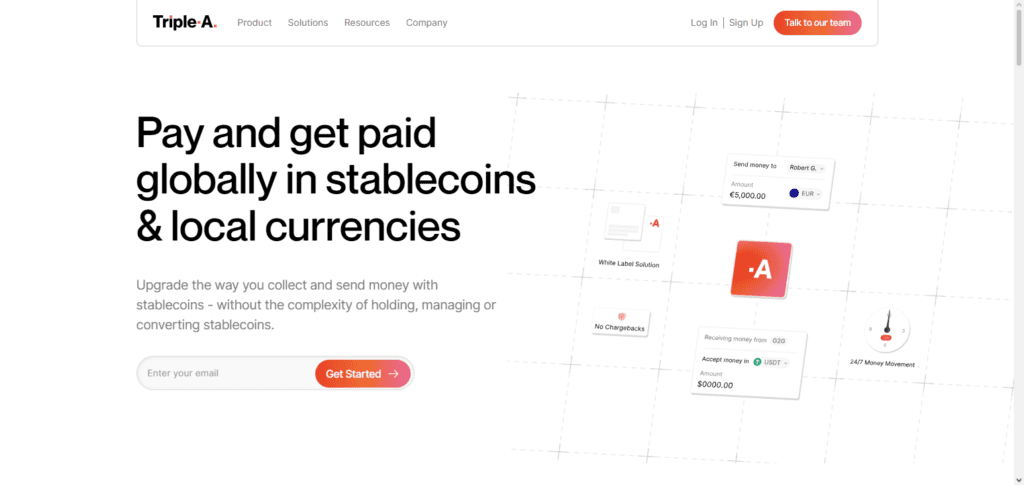
Firms can accept crypto payments and make crypto payouts while avoiding the management of digital assets. Predictable local-currency settlement with borderless compliance. Good for firms with global traders.
Features to Look for in a Crypto Payment Solution
| Feature | Description |
|---|---|
| Multi-Currency Support | Allows prop firms to accept multiple cryptocurrencies like BTC, ETH, USDT, and USDC. |
| Stablecoin Support | Helps reduce price volatility by enabling payments through stable assets. |
| Fast Transaction Processing | Ensures quick deposits, confirmations, and trader payout settlements. |
| API Integration | Connects payment systems with websites, trading platforms, and dashboards. |
| Automated Payment Verification | Confirms blockchain transactions automatically and updates user accounts instantly. |
| Low Transaction Fees | Reduces payment costs compared to traditional international banking methods. |
| Secure Wallet Management | Protects company funds through encrypted wallets and security controls. |
| Blockchain Network Support | Provides access to multiple networks such as Ethereum, TRON, Polygon, and Solana. |
| Fiat Conversion Options | Allows firms to convert crypto payments into traditional currencies when needed. |
| Global Payment Accessibility | Enables traders worldwide to make payments without regional banking limits. |
| Recurring Payment Support | Helps manage subscription-based challenges, memberships, or account fees. |
| Transaction Tracking & Reporting | Provides detailed records of payments, withdrawals, and financial activities. |
| KYC & AML Compliance Tools | Helps prop firms follow regulatory requirements and prevent fraudulent transactions. |
| Refund Management | Allows firms to process crypto refunds efficiently and securely. |
| Scalable Infrastructure | Supports increasing transaction volumes as the prop firm grows. |
| User-Friendly Checkout Experience | Provides simple payment options for traders with minimal steps. |
| Multi-Signature Security | Adds additional approval layers for protecting company crypto assets. |
| 24/7 Payment Availability | Allows traders to make payments anytime without banking hour restrictions. |
| Real-Time Notifications | Sends instant alerts for successful payments and transaction updates. |
| Developer Support | Provides documentation, technical assistance, and integration resources. |
Crypto Payment Security Practices for Prop Firms
Non-Custodial Wallets – Storing funds in wallets where firms have control of the private keys, reduces the dependence on third parties and the risk of relying on wallets that can be hacked.
Multi-Signature (Multi-Sig) Wallets – Access to the wallet is gained through several approvals. If one of the approval accounts is hacked, the funds in the wallet cannot be accessed.
Cold Storage for Reserves – Keeping funds in wallets that are not connected to the internet. Only the funds that are needed for day-to-day operations are kept in Hot Wallets.
Regulated & Audited Payment Gateways – Payment processors, like BVNK and Triple-A, that are licensed to process payments and comply with security audits are preferred.
Stringent KYC and AML Checks – Identifying the trader for high value transactions is necessary to avoid loss of funds due to money laundering and chargeback transactions.
Two-Factor Authentication (2FA) Checks – 2FA must be used to access all admin accounts, payment screens, and wallets.
Real-Time Transaction Monitoring – Automate alerts for abnormal transaction activity and large withdrawals.
Withdrawal Address Whitelisting – Withdrawals are restricted to approved wallet addresses.
Sensitive Data Encryption – API keys, wallet keys, and customer data are encrypted in both storage and transit.
Security Penetration & Vulnerability Tests – Regularly testing the payment systems for vulnerabilities.
Thorough Transaction Records – Maintaining permanent records of every crypto transaction.
Educating Staff on Phishing and Social Engineering – Employees need to learn that some phishing attempts target wallet access as well as attempts to get admin access.
Rate Limiting and Withdrawal Caps – If there is a security breach, loss can be limited if there is a daily or weekly cap on how much can be withdrawn.
Working with Insured Custodial Providers (if Applicable) – If custodial services are utilized, ensure insurance against theft or hacks are included.
Continuous Monitoring for Blockchain Network Security – Watch for network vulnerabilities (e.g., smart contract exploits) of the cryptocurrencies you accept.
Compliance and Regulatory Considerations
| Compliance Area | Description |
|---|---|
| Know Your Customer (KYC) | Verify trader identities before accepting crypto payments to prevent fraud and unauthorized activities. |
| Anti-Money Laundering (AML) | Implement AML procedures to monitor transactions and detect suspicious crypto activities. |
| Crypto Payment Regulations | Follow local and international cryptocurrency payment laws applicable to the prop firm’s operating regions. |
| Licensing Requirements | Check whether crypto payment acceptance requires financial licenses or regulatory approvals. |
| Transaction Monitoring | Track blockchain transactions to identify unusual payment patterns and reduce financial risks. |
| Customer Due Diligence (CDD) | Collect and review trader information to assess potential compliance risks. |
| Data Protection Rules | Protect trader personal information according to privacy regulations and security standards. |
| Tax Reporting Compliance | Maintain accurate records of crypto transactions for reporting income, fees, and payouts. |
| Wallet Security Controls | Use secure wallets, access controls, and authentication methods to protect digital assets. |
| Record Keeping | Maintain detailed transaction histories, invoices, and payment records for audits. |
| Sanctions Screening | Check users and transactions against restricted or sanctioned entity lists. |
| Risk Management Policies | Create procedures for handling crypto volatility, fraud attempts, and payment disputes. |
| Payment Provider Compliance | Select crypto gateways that follow industry regulations and provide compliance tools. |
| Stablecoin Regulations | Monitor changing rules related to stablecoins used for trader payments and withdrawals. |
| Cross-Border Payment Rules | Understand international regulations when accepting crypto payments from global traders. |
| Consumer Protection | Provide clear payment terms, refund policies, and withdrawal guidelines for traders. |
| Smart Contract Security (If Used) | Audit blockchain-based payment systems to prevent technical vulnerabilities. |
| Regular Compliance Reviews | Update policies regularly to match changing crypto regulations and industry standards. |
Challenges of Accepting Crypto Payments
Price Volatility – The price of cryptocurrencies is highly unstable. This can lead to risk if organizations do not exchange such funds into stablecoins or fiat quickly.
Regulatory Uncertainty – Laws and regulations concerning cryptocurrency change rapidly and are different from one country to another, making it difficult to determine how a regulation will affect a business.
KYC/AML Compliance Burden – Frequent monitoring and the verification of a trader’s identity are added burdens.
Irreversible Transactions – Unlike card payments, transactions made through crypto are permanent. This means if a payment was made for the incorrect amount or sent to the wrong address, those funds are lost.
Limited Consumer Protection – No chargeback means that claims against the non-delivery of services after payment are difficult.
Security Risks – Digital wallets, private keys, and account exchanges are subjects of attacks.
Technical Complexity – A high level of skill is required to manage cryptocurrencies and confirm transactions on the blockchain.
Tax Reporting Complications – Fulfillment of different reporting requirements of each jurisdiction can be difficult.
Limited Mainstream Adoption – Not all traders are comfortable using and transacting cryptocurrency.
Network Congestion & Fees – A busy blockchain can lead to a drastic increase in the cost to complete a transaction.
Banking & Payment Processor Restrictions – Some banks may limit accounts that are tied to crypto, making it difficult to exchange cryptocurrency for fiat.
Fraud and Scam Threats – Phishing sites and fake wallet addresses and payment confirmations are other threats to crypto payments.
Differing Processes – Variability in wallet and payment gateway processes and differing blockchains create a poor payment process ecosystem.
Support Obstacles – Unlike other conventional payment methods, resolving issues related to crypto payments is more difficult in the absence of support systems.
Reputation Risk – Delving into the crypto business means a greater level of scrutiny from regulators and traditional business partners and clients.
Future Trends of Crypto Payments for Prop Firms in 2026

By 2026, global payment alternatives in the proprietary trading industry will inevitably include electronic crypto payment systems. Financial Blockchain technology automates secure digital settlements, enhancing the efficiency and security of proprietary trading firms.
To remain competitive, firms will likely integrate AI-driven, real-time transaction monitoring, stablecoins, and Web 3 payment systems. These innovations will enable immediate deposit and withdrawal transactions for traders. As regulations solidify, trading firms will benefit from the rapid growth of electronic crypto payment systems.
Conclusion
For prop trading firms, crypto payments have become a competitive offering to attract a global network of traders. Traditional payment methods don’t stand up to crypto transactions which are more affordable and convenient, faster and easier to use, and available every hour of every day.
The equilibrium is maintained by trade-offs. Prop trading firms will be forced to bear some trade-offs such as price and regulatory volatility and risk to security. These will require some risk management.
Crypto payments are faster, more convenient, and don’t rely on third-party financing. Prop trading firms will have to trade security and price volatility to give traders a better option. The prop trading firms who will have the most market share and be most successful when crypto payments become the norm will be the firms to accept them today.
FAQs
Yes, in most countries prop firms can legally accept crypto payments, but requirements vary by jurisdiction. It’s important to consult local regulations and implement proper KYC/AML procedures to stay compliant.
Stablecoins like USDT and USDC are the most preferred, as they avoid price volatility while offering fast, low-cost transactions — making them ideal for both fees and payouts.
Yes, firms need either a self-custody wallet or an account with a crypto payment gateway that provides wallet infrastructure to receive and manage funds.
Confirmation times vary by network — Bitcoin can take 10–60 minutes, while stablecoins on networks like Tron (TRC20) or Solana often confirm within seconds to a few minutes.
Yes, when proper security practices are followed — such as multi-sig wallets, cold storage, 2FA, and using regulated payment gateways — crypto payments can be very secure.
