


As AI applications evolve, businesses need reliable evaluation platforms that can assess model accuracy, reasoning, consistency and overall performance at multiple stages. Choosing the right evaluation tool can have a large impact on finding errors, improving workflow and keeping the quality of AI up. Top Texaris Rivals for Multi-Stage Evaluation Models In this article, I will compare the key features, evaluation capabilities, integrations, and limitations of these top Texaris competitors to help developers and businesses find suitable alternatives for their AI testing requirements.
What Are Multi-Stage Evaluation Models?
Multi-stage evaluation models are testing systems that evaluate AI models, large language models (LLMs) and AI agents in a number of evaluation stages. They don’t judge a model on a single test, but rather look at accuracy, reasoning, relevance, consistency, safety, and reliability. These models use automated testing, custom evaluation metrics, benchmark datasets and scoring mechanisms to identify weaknesses at every stage. They enable developers to compare model versions, find bugs, improve response quality and verify AI applications behave consistently before and after deployment.
How to Choose the Best Texaris Rival?
Multi-Stage Evaluation Capabilities: Look for a platform that supports multiple stages of testing such as model accuracy, reasoning, response quality, reliability and safety testing on various AI workflows.
Automated Testing Support: Look for automated evaluation features to minimize manual testing, speed up model comparisons, detect errors, and maintain consistent evaluation throughout development and deployment.
Custom Evaluation Metrics: Select tools that allow you to define your own scoring methods, evaluation criteria, and performance benchmarks, making sure they match the unique requirements of your application and the various testing scenarios for AI models.
AI Agent Evaluation: Verify if the platform allows testing AI agents with multi-step reasoning tests, tool calling tests, and workflow validation for incrementally more complex autonomous applications.
Compatibility with Existing Systems: Assess how well the solution integrates with current AI frameworks, APIs, development environments, data pipelines, and monitoring systems to facilitate smoother implementation and minimize integration hurdles.
Tracing and Debugging: Look for platforms that provide detailed execution traces, error identification, and debugging tools, so you can see where things are going wrong and optimize performance at each stage of evaluation.
Scalability and Deployment: Check the infrastructure flexibility, the deployment options, the processing power, and the data management capabilities to ensure that the platform can effectively handle increasing evaluation loads.
Pricing and Security: Compare subscription costs, usage limits, data protection, control of access and security features to find a solution that meets budget requirements without compromising the reliability of evaluation.
10 Top Texaris Rivals for Multi-Stage Evaluation Models
1. Braintrust – Supports dataset-based evaluations, custom scoring, experiment tracking, and production monitoring.
2. LangSmith – Provides multi-step tracing, dataset testing, prompt evaluation, and agent workflow monitoring.
3. Arize AI – Offers model evaluation, tracing, performance monitoring, and debugging for AI applications.
4. Weights & Biases Weave – Combines experiment tracking, evaluation scoring, trace analysis, and model comparisons.
5. Confident AI (DeepEval) – Provides automated testing, custom evaluation metrics, regression testing, and CI/CD integration.
6. Galileo – Focuses on agent evaluation, hallucination detection, quality scoring, and production guardrails.
7. Langfuse – Offers LLM tracing, evaluation datasets, prompt management, and application performance monitoring.
8. Patronus AI – Specializes in hallucination detection, automated evaluation, safety testing, and AI quality assessment.
9. Maxim AI – Supports agent simulations, evaluation workflows, prompt experiments, and production quality checks.
10. Opik by Comet – Provides experiment tracking, LLM evaluation, debugging, and monitoring for AI agents and applications.
1. Braintrust
Braintrust is an evaluation-first platform for building, testing and improving AI agents and LLM apps. It adds tracing, datasets, experiments, prompt playgrounds and CI/CD-oriented evaluation allowing teams to turn production failures into regression tests. Its multi-stage evaluation enables offline experiments, online monitoring, LLM-as-a-judge scorers, code-based scorers, and human review.

The pricing is based on usage and not per seat: The free Starter tier includes 1 GB of processed data and 10,000 scores, while the Pro starts at $249 per month. For enterprise users it can be deployed on a hybrid or private-cloud setup. Braintrust integrates with Github Actions, OpenTelemetry, LangChain, LlamaIndex, DSPy, CrewAI, and OpenAI Agents SDK.
Characteristics
- Supports automatic LLM evaluation with user-defined scoring functions and evaluation datasets.
- Experiment tracking to compare different prompts, models, and application versions.
- Provides detailed tracing to identify errors in multi-step AI workflows.
- Allows custom evaluation metrics to evaluate accuracy, relevance and quality of the response.
- Enables production monitoring to observe how AI applications perform over time.
constraints
- Technical setup and development knowledge may be needed for complex evaluation workflows.
- Increased volumes of evaluation and tracing may increase costs.
- Custom scoring functions require extra setup and maintenance.
4.Complex projects may require strict dataset organization and evaluation management.
2. LangSmith
LangSmith is LangChain’s observability and evaluation platform specifically built for teams building with LangChain and LangGraph. It traces model calls, retrievals, tools, and agent steps, and links these runs to datasets, experiments, human feedback, and online evaluation. Evaluation stack consists of LLM judges, custom evaluators, dataset collection, regression testing and multi-turn conversation simulation.

Pricing is per seat. Developer is free with limited usage, Plus is $39 per seat/month with 10,000 base traces included, and Enterprise is self-hosted or hybrid. LangSmith is tightly integrated with LangChain workflows, supports OpenTelemetry ingestion, and has a Prompt Hub for versioned prompts.
Main Features
- Enables end-to-end tracing for debugging multi-step LLM applications and agent workflows.
- Assists in building and evaluating datasets for testing model responses.
- Fast management and version tracking for consistent experimentation.
- Lets you compare the performance of different models and application configurations.
- It integrates with LangChain-based applications and supports broader LLM development workflows.
Limitations**
- Some advanced capabilities might necessitate familiarity with its development ecosystem.
- Large datasets of traces can increase operational complexity.
- Further configuration may be needed for large evaluation workflows.
- When dealing with high-volume applications, usage-based costs should be considered.
3. Arize AI
Arize AI offers AI observability and evaluation with Arize AX and its open-source Phoenix project. It’s powerful for teams who want production monitoring along with LLM evaluation: OpenTelemetry/OpenInference tracing, span-level analysis, drift detection, embedding visualization, and failure clustering. It can do online and offline evaluations, has LLM-as-a-judge templates for relevance, hallucination, and toxicity, and supports custom evaluators, datasets, and experiments.

Phoenix is free and self-hostable under the Elastic License 2.0 while Arize AX Free has 25,000 spans/month and Pro starts at $50/month. Arize is designed to integrate with OpenTelemetry-native stacks, supports prompt versioning and playgrounds, and scales from local experimentation to enterprise observability.
Main Features
- Provides AI observability to monitor model performance and application behavior.
- Supports tracing of LLMs to debug errors in complex AI workflows.
- Provides evaluation capabilities to assess the quality and reliability of answers.
- Helps to identify hallucinations, performance issues and unexpected model behavior.
- Supports monitoring in both development and production.
Restrictions
- You might require technical know-how to install it the first time.
- Advanced observability features can be a little learning curve.
- Large scale monitoring may require careful management of resources and costs.
- Additional implementation work may be required to meet custom evaluation requirements.
4. Weights & Biases Weave
Weights and Biases Weave is the LLM observability and evaluation layer of the broader W&B machine learning platform. This is useful for multi-agent systems as it captures nested traces for models, tools, functions, latency, token usage, and agent steps. Teams can run evaluations with built-in and custom scorers, LLM-as-a-judge scoring, leaderboards, side-by-side comparisons, production monitors and versioned prompt objects.

The benefit is that it plugs into the W&B ecosystem of training, fine-tuning, sweeps and model-registry. The free tier offers 1 GB/month of Weave ingestion, and Pro starts at roughly $60/month, with ingestion billed separately. Weave supports Python and Typescript instrumentation, OpenTelemetry ingestion, and enterprise self hosted deployment.
Highlights
- Visualize LLM app executions with granular traces and call stacks.
- Contains evaluation datasets to assess the quality of model responses.
- Allows for comparison between different models, prompts and experiments.
- Offers custom scoring functions to meet application-specific evaluation requirements.
- Enables monitoring and debugging of AI-enabled workflows.
Limitations:
- Using advanced features might require some knowledge of the Weights & Biases ecosystem.
- Complex evaluation pipelines might cost more in development.
- The operational overhead can increase when handling large traces and datasets.
- Some features may be subject to subscription plans and use requirements.
5. AI with confidence
Confident AI is a developer-first LLM testing and evaluation platform built on the open-source DeepEval framework. It is centered around pytest-native workflows that allow engineering teams to define test cases, assertions, metrics, and evaluation suites in code and run them through CI/CD.
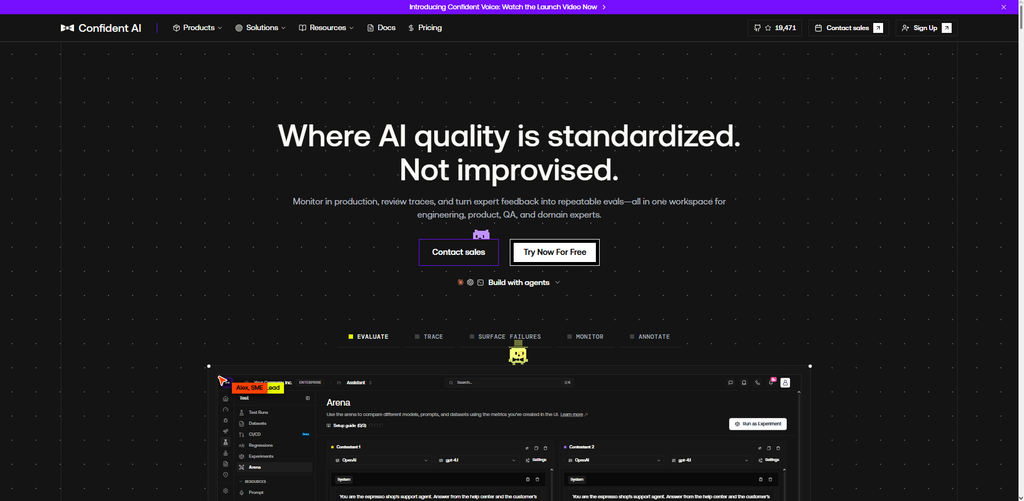
It supports multi-stage evaluation with unit-style LLM tests, trajectory and tool-call scoring, synthetic data set generation, regression testing, and production monitoring. Its open-source core allows easy implementation of custom metrics and evaluators in Python.
The Starter plan starts at $200/month. The Free tier includes 5 test runs per week, 1 GB of trace spans and 2 seats. It’s best suited for teams looking for evaluation as part of software-testing pipelines.
Key Benefits
- Automated LLM evaluation based on fixed and customizable testing metrics.
- Helps identify hallucinations and assess factual accuracy.
- Supports regression testing to find quality changes between model versions.
- Provides evaluation datasets for testing various AI application scenarios.
- Enables integration with development pipelines for continuous AI testing.
Restrictions
- Some advanced metrics may require technical know-how to set up.
- Custom implementation for complex evaluation scenarios.
- Large-scale testing can be costly in terms of computation and operation.
- Advanced features are dependent on the platform plans and configuration.
6. Galileo
Galileo is an AI reliability and evaluation platform that helps teams detect, diagnose and prevent LLM failures across development and production. It has tracing and evaluation datasets, automated quality metrics, human feedback and guardrails for production applications. Its evaluation approach consists of offline experiments, online monitoring, LLM-as-a-judge scoring, custom metrics, and root-cause analysis of failed interactions.

Galileo is designed for enterprise teams looking for a single system for observability, safety controls, and workflows to drive continuous improvement. Pricing is generally not entirely public and is usually customized for enterprise use, data volume, retention and deployment requirements. It is also extensible to popular LLM frameworks and observability pipelines, allowing teams to embed evaluations in CI/CD and production monitoring flows.
Highlights
- Offers AI evaluation tools to test LLM applications and autonomous agents.
- Helps detect hallucinations and assess the quality of the response.
- Provides real-time monitoring to identify problems with AI application performance.
- Provides evaluation metrics for quantifying reliability and accuracy of responses.
- Allows tracing and debugging across multi-step AI workflows.
Limitations
- May require technical expertise to set up initially.
- Managing advanced evaluation configurations can be time consuming.
- High volumes of monitoring may increase the cost of platforms.
- Specialized evaluation needs may require custom metrics and integrations.
7. langfuse
Langfuse is an open-source-first LLM engineering platform for tracing, prompt management, evaluation and analytics. Its MIT-licensed core can be self-hosted, with core features available without usage limitations, which is attractive to teams that want control over data and infrastructure. It supports multi-stage evaluation with datasets, experiments, LLM-as-a-judge scoring, custom evaluators, human feedback, and online evaluation of production traces.

Langfuse captures prompts, completions, tool calls, latency, token usage, and cost and can turn selected traces into evaluation datasets. Its Hobby tier includes 50,000 units/month and two users, with Pro starting at $199/month. It integrates via Python and JavaScript SDKs, OpenTelemetry, and popular LLM frameworks.
Features
- Provides fine-grained tracing to trace multi-step LLM application executions.
- Allows rapid management and versioning for AI development.
- Allows evaluation capabilities using datasets and custom scoring methods.
- Supports usage tracking and performance monitoring of LLM applications.
- Ability to self-host and integrate with various AI development frameworks.
Limitations
- Self-hosting means infrastructure management and upkeep.
- For more complex setups, developer knowledge may be required.
- Tracing volumes may become large and storage requirements grow.
- Custom evaluation workflows may require additional resources.
8. Patronus AI
Patronus AI works on simulation-based evaluation, testing and training for AI agents. Its platform is designed to evaluate agent behavior in realistic scenarios using simulated environments, digital world models, and reinforcement-learning-style evaluation environments. It enables multi-stage evaluation including scenario generation, agent-behavior testing, tool-use assessment, failure analysis and custom evaluation criteria.

Patronus also has research models such as Lynx and GLIDER for judgment and evaluation tasks. Pricing isn’t public, and organizations usually have to reach out to sales to roll it out enterprise-wide. For teams building autonomous agents that need to be validated on complex multi-step tasks before production release, Patronus is the ideal solution.
Key Features
- Offers automated evaluation of LLM response quality and reliability.
- Enables hallucination detection and fact-consistency checking.
- Assigns an AI safety rating to detect potentially harmful outputs.
- Supports custom evaluation workflows for different business needs.
- Provides testing and monitoring of AI applications throughout development workflows.
Limitations
- Special evaluation features may require additional configuration.
- The cost of implementing custom testing requirements may be a factor.
- Quality of criteria and test datasets influence evaluation accuracy.
- Enterprise level requirements could increase the total cost of the platform.
9. AI Maxim
Maxim AI is an AI observability and quality management platform for evaluating AI for teams building LLM apps and agents. It supports end-to-end workflows for dataset creation, prompt experimentation, automated evaluations, human review, production monitoring and root cause analysis. It offers multi-stage evaluation capabilities, such as offline test suites, online quality monitoring, LLM-as-a-judge metrics, custom evaluators, and agent trajectory analysis.

Engineering, product and domain-expert teams work together, and non-technical reviewers can be involved in the evaluation and feedback loops, says Maxim. It offers integrations with popular LLM frameworks and observability standards for evaluation within CI/CD and production pipelines. Pricing is generally usage and enterprise-based with plans that correlate to data volume, seats, retention and deployment needs.
Main Features
- Provides tools for simulating AI agents in different scenarios.
- Facilitates automated evaluation of LLM applications and agent workflows.
- Provides fast trialing and versioning capabilities.
- Allows performance monitoring with detailed traces and evaluation results.
- Enables collaborative workflows for AI development and quality assurance.
Restrictions
- Some advanced simulation workflows may need to be established first.
- May require more development effort for complex testing scenarios.
- Large scale evaluations may increase resource consumption.
- Certain advanced features are available only on higher plans
10. Comet by #Opik
Opik by Comet is an open-source LLM evaluation and observability platform that integrates seamlessly into Comet’s experiment tracking ecosystem. It offers tracing, prompt management, datasets, experiments, evaluation suites, LLM-as-a-judge scoring, custom metrics, and production monitoring. Its evaluation model uses test suites that are assertion-centric and can simulate multi-turn user interactions using an LLM-based user simulator.

The open-source tier provides unlimited spans, seats and retention to self-hosted deployments. Comet’s Pro Cloud starts at $19/month, with a free cloud tier supporting up to 10 team members. Opik supports trace-level logging of tool-calls and steps. Opik integrates with Comet experiments and is well suited for teams wanting a self-hostable evaluation stack based on Apache-2.0.
Main Features
- Offers LLM tracing to trace and debug AI application workflows.
- Facilitates automated evaluation with datasets and user-defined metrics.
- Enables tracking of experiments and comparing different versions of the model.
- Provides tools for evaluating AI agents and multi-step applications.
- Supports open-source deployment and integration with various development frameworks.
Limitations
- Self-hosted deployment needs infrastructure and maintenance resources.
- Complex evaluation workflows may require programming skills.
- Mass tracing may increase storage and processing requirements.
- Complex integrations may need further developer configuration.
Conclusion
The selection of an appropriate Texaris competitor for multi-stage evaluation models is driven by evaluation needs, test complexity, and scalability requirements. Braintrust LangSmith Arize AI Weights & Biases Weave Confident AI Galileo Langfuse Patronus AI Maxim AI Opik These platforms offer a variety of features for automated testing, custom scoring, AI agent evaluation, tracing, and performance monitoring.
Before choosing a platform, look at the evaluation metrics, integration support, deployment flexibility, pricing and security features of the platform. The best solution should streamline testing workflows, pinpoint model deficiencies, enhance response quality, and foster the creation of dependable AI applications as the need for evaluation grows.
FAQ
Multi-stage evaluation models assess AI systems through multiple testing stages, including accuracy, reasoning, relevance, safety, consistency, and reliability to improve overall model performance.
Braintrust, LangSmith, Arize AI, Weights & Biases Weave, Confident AI, Galileo, Langfuse, Patronus AI, Maxim AI, and Opik are notable platforms in the AI evaluation category.
Braintrust, Confident AI, Galileo, LangSmith, and Opik provide evaluation capabilities that help automate testing, assess model responses, and identify performance issues.
They help developers identify errors at different testing stages, measure model reliability, detect hallucinations, evaluate reasoning quality, and improve AI application performance.
Yes. Platforms such as Maxim AI, Galileo, Braintrust, LangSmith, and Opik offer capabilities for evaluating AI agents, tracing execution, and assessing multi-step workflows.
